
Quick Answer
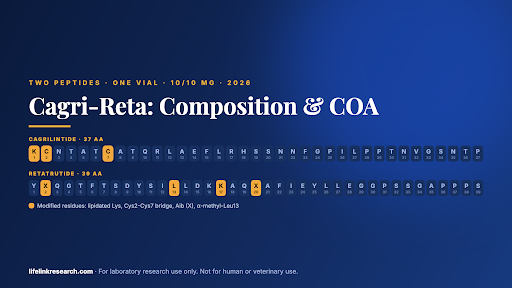
Cagri-Reta is a research blend of two synthetic peptides in one vial: cagrilintide, a long-acting amylin analog (4409.0 g/mol), and retatrutide (LY3437943), a GIP, GLP-1 and glucagon receptor triple agonist (4731.34 g/mol). A typical vial holds 10 mg of each, and its COA needs a separate identity and purity result for both.
Key takeaways
- Cagri-Reta pairs cagrilintide (Novo Nordisk) and retatrutide (Eli Lilly), usually 10 mg + 10 mg
- Cagrilintide: 37 residues, C194H312N54O59S2, 4409.0 g/mol, CAS 1415456-99-3
- Retatrutide: 39 residues, C221H342N46O68, 4731.34 g/mol, CAS 2381089-83-2
- The two bind different receptor families: amylin/calcitonin vs GIP, GLP-1 and glucagon
- A blend COA should show two resolved HPLC peaks and two mass-spec matches
Cagri-Reta is a two-peptide research blend of cagrilintide and retatrutide, typically 10 mg of each per vial. The two molecules weigh within about 320 daltons of each other, yet they bind completely different receptor families, and that pairing is the whole reason the blend exists.
Cagrilintide is a long-acting amylin analog from Novo Nordisk. Retatrutide is Eli Lilly’s single-molecule agonist at three receptors. Both are lipidated peptides, both run as large molecules on an HPLC column, and both need their own identity result on a blend COA.
This guide covers each molecule’s identity and structure, its receptor targets, how to read a two-peptide COA, and where each compound stands in October 2026. Our Cagrilintide + Retatrutide 10/10 mg is the example used throughout.
What Is Cagri-Reta?
Quick answer: Cagri-Reta is a research blend that combines two separate synthetic peptides in one lyophilized vial: cagrilintide, a long-acting amylin analog, and retatrutide (LY3437943), a single peptide that binds the GIP, GLP-1, and glucagon receptors. Life Link’s version contains 10 mg of each, with its batch documents published on the product’s certificate page.
The blend travels under several names, which can make catalogues confusing:
- Cagri-Reta or Reta-Cagri: the two short forms joined, in either order.
- Reta + Cagri: the same pairing written as two parts, or as plain cagri reta without the hyphen.
- GLP-3 + cagrilintide: “GLP-3” is an informal nickname for retatrutide, coined because it reaches a third receptor. No receptor called GLP-3 exists.
Every one of these names points to the same two molecules, and the label should always state the amount of each.
The reason they’re studied together is simple. Cagrilintide works on amylin and calcitonin receptors. Retatrutide works on the incretin and glucagon receptors. Because the two sets of receptors don’t overlap, a single model can carry both signals at once, and a researcher can compare that with either compound alone.
Cagrilintide vs Retatrutide: Side-by-Side Identity Table
The table below contains the reference identity data for both compounds in one place. Every value comes from a public database or the developer’s own publication, linked below the table.
| Property | Cagrilintide | Retatrutide |
| Developer | Novo Nordisk | Eli Lilly |
| Code | AM833 (also listed as NN0174-0833) | LY3437943 |
| Class | Long-acting amylin analog | GIPR, GLP-1R and GCGR triple agonist |
| Length | 37 amino acids | 39 amino acids |
| Formula | C194H312N54O59S2 | C221H342N46O68 |
| Molecular weight | 4409.0 g/mol | 4731.34 g/mol |
| CAS | 1415456-99-3 | 2381089-83-2 |
| Key modifications | Cys2 to Cys7 disulfide bridge; C20 fatty diacid on the N-terminus through a γ-glutamic acid linker; C-terminal proline amide | Aib at positions 2 and 20; α-methyl-leucine at 13; fatty diacid side chain on Lys17 through a linker |
| Receptor targets | Amylin receptors AMY1, AMY2, AMY3 and the calcitonin receptor | GIP receptor, GLP-1 receptor, glucagon receptor |
Sources: cagrilintide formula, weight, CAS, and structure from PubChem CID 171397054 and its design paper (Kruse et al., J Med Chem, 2021). Retatrutide formula, weight, sequence, and targets from KEGG D12430; its Lys17 acylation site from the receptor-structure study by Li et al., Cell Discovery, 2024.

Cagrilintide and retatrutide identity data side by side, with what a blend COA should show.
Two details from the table come up again on any blend COA. The weights differ by roughly 322 Da, which lets a mass spectrometer tell the two apart without trouble. And both molecules carry a fatty side chain, so both behave as greasy, slow-eluting peptides on a reverse-phase HPLC column.
What Is Cagrilintide?
Quick answer: Cagrilintide is a synthetic, long-acting analog of the hormone amylin, developed by Novo Nordisk. It is a lipidated peptide with a disulfide bridge, and it binds amylin receptors (AMY1, AMY2, and AMY3) and the calcitonin receptor. In research, it is studied as a receptor-binding and assay tool; it has no FDA approval as a standalone product.
Structure and Modifications
Cagrilintide is 37 amino acids long and starts from the amylin sequence. A disulfide bridge between Cys2 and Cys7 closes a small ring near the N-terminus, the same ring native amylin carries. The C-terminal half contains three prolines at positions 25, 28, and 29, and the chain ends in a proline amide.
The long-acting part comes from lipidation. A C20 fatty diacid is attached to the N-terminal lysine through a γ-glutamic acid linker. Novo Nordisk’s chemists described that design choice in their 2021 development paper.
Receptor Targets: AMY1-3 and the Calcitonin Receptor
Amylin receptors are built from two parts. The calcitonin receptor (CTR) pairs with one of three receptor activity-modifying proteins, RAMP1, RAMP2, or RAMP3, to form AMY1, AMY2, and AMY3. Cagrilintide activates all three as well as CTR on its own.
In cell assays, binding is usually read out as cAMP, the second messenger these receptors raise. Researchers express CTR with or without a given RAMP and compare cAMP responses across those cell lines to map a ligand’s receptor profile. A single-compound cagrilintide 5 mg vial suits that kind of side-by-side assay.
What Is Retatrutide?
Quick answer: Retatrutide (LY3437943) is a 39-amino-acid synthetic peptide developed by Eli Lilly. One molecule activates three receptors (GIPR, GLP-1R, and the glucagon receptor), which is why it is called a triple agonist. It carries a fatty-acid side chain for albumin binding. As of 31 October 2026, it is investigational and not FDA approved.
Structure: Aib Substitutions and Lipidation
Retatrutide’s sequence reads YXQGTFTSDYSILLDKKAQXAFIEYLLEGGPSSGAPPPS, where each X is Aib (α-aminoisobutyric acid). The Aib at position 2 resists cleavage by the DPP-4 enzyme, and a second Aib appears at position 20. Position 13 carries α-methyl-leucine, another non-natural residue.
The fatty diacid side chain is attached to Lys17 through a linker. That side chain lets the peptide bind albumin reversibly. Lilly’s discovery team set out the design in Cell Metabolism in 2022.
Triple Receptor Binding (GIPR / GLP-1R / GCGR) in Assay Terms
All three of retatrutide’s receptors belong to the class B GPCR family, and all three raise cAMP when activated. That makes them easy to compare in the same assay format. Researchers typically use cell lines that express a single human receptor each and measure cAMP across a range of concentrations.
Those concentration-response curves show how potent the peptide is at each receptor relative to the native hormones, GIP, GLP-1, and glucagon. Cryo-EM structures published in 2024 show how one ligand fits all three binding pockets. For single-compound work, a retatrutide 15 mg vial keeps the triple agonist on its own.
Why Are Cagrilintide and Retatrutide Researched Together?
Quick answer: Researchers pair them because they act on different receptor families: amylin/calcitonin receptors for cagrilintide, and incretin/glucagon receptors for retatrutide. This lets studies compare single-receptor and multi-receptor signaling in one model. The combination itself has so far been described only in animal work, while each molecule has its own separate research history.
The evidence comes in two clearly separate piles:
- The combination: one published study, in rats. Petersen and colleagues reported it in Nature Metabolism in October 2026, and it remains the only peer-reviewed paper on this exact pairing.
- Cagrilintide alone: its own development line at Novo Nordisk, from in vitro receptor work through a human clinical programme.
- Retatrutide alone: its own programme at Eli Lilly, from receptor pharmacology through Phase 3 human trials.
In assay terms, the pairing makes a tidy experiment. One ligand reaches receptors built from CTR and RAMPs, the other reaches three class B GPCRs, and all of them raise cAMP. That shared readout lets a researcher measure both signals the same way and see how they combine.
So a blend of the two draws on two long, separate histories and one new animal study of them together.
Blend vs Separate Vials
A cagrilintide retatrutide blend in one premixed 10/10 mg vial and two single vials hold the same molecules. They suit different study designs.
| Feature | Cagri-Reta blend (one vial) | Two single vials |
| Consistency | Both peptides come from one mixing step, so every vial in the batch shares the same pairing | Each compound has its own batch |
| Documentation | One COA covers both compounds | Two COAs, one per compound |
| Study design | Built for work that needs both compounds together | Lets each compound run alone as well as together |
Separate vials make controls easier, since a study can run cagrilintide alone, retatrutide alone, and both together from known lots. The blend keeps handling simple, with one vial and one document to track per batch. For a fuller comparison, read our guide to peptide blends vs single vials.
How to Read a Cagri-Reta COA
Quick answer: A Cagri-Reta COA should show two separate identity and purity results, one for each peptide. Look for two resolved HPLC peaks, a mass-spec match for each compound’s expected molecular weight (about 4409 and 4731 Da), the content of each per vial (10 mg + 10 mg), and a lot number matching your vial.
A single retatrutide COA has one molecule to prove. A blend report has two, and it has to show each one in the right amount.
Two HPLC Peaks and Resolution
On a single-peptide chromatogram, purity is the main peak’s share of the total area. A blend chromatogram should show two main peaks, one per compound, each with its own retention time. They need to be resolved, meaning separated down to the baseline, so each area can be measured cleanly. Two merged peaks reported as a single percentage can’t tell you how pure each component is. Both molecules carry fatty side chains and tend to elute late, so a method that separates them cleanly shows the lab tuned it for this blend.
MS Confirmation for Each Peptide
Mass spectrometry confirms that each peak is the molecule it should be. Look for two observed masses, one near 4409 Da for cagrilintide and one near 4731 Da for retatrutide, each within the lab’s stated tolerance. Large peptides often show up as several charge states, which the lab converts to a single mass. The amount of each peptide per vial comes from a separate measurement against a reference standard, reported in mg. Our guide to HPLC vs mass spectrometry explains how the two methods divide the work.
Lot, Date and Lab Checks
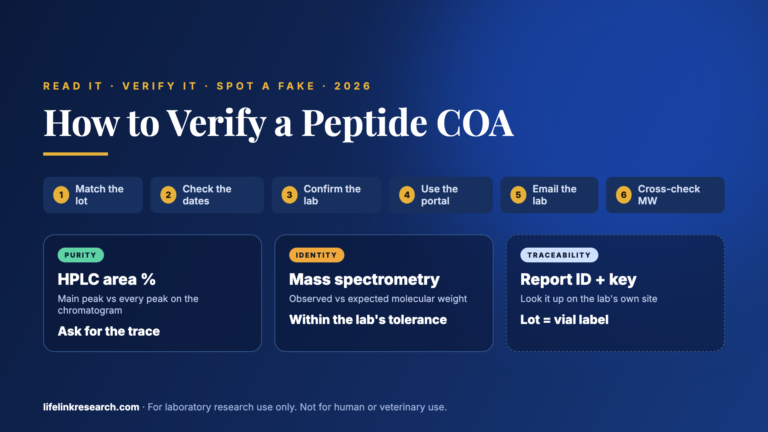
The paperwork checks are the same as for any peptide. Match the lot number to the vial label, confirm the test date fits the batch, and verify the report with the lab using its key or QR code. For a blend, also confirm the sample line names both compounds and both amounts, since a report for either single peptide can’t stand in for the blend. Our step-by-step guide on how to verify a peptide COA walks through all six checks.
Is Cagri-Reta FDA Approved?
Quick answer: No. As of 31 October 2026, neither the Cagri-Reta blend nor retatrutide on its own is FDA approved. Retatrutide remains investigational with Eli Lilly, and cagrilintide is in development with Novo Nordisk, including as part of CagriSema. Research blends like Cagri-Reta are sold for laboratory research use only.
Here’s the dated record behind that answer:
| Date | Event | Source |
| Aug 2021 | Novo Nordisk chemists publish cagrilintide’s design | J Med Chem |
| Sep 2022 | Lilly scientists describe the discovery of LY3437943 | Cell Metabolism |
| 18 Dec 2025 | Novo Nordisk submits a New Drug Application to the FDA for CagriSema (cagrilintide with semaglutide) | Novo Nordisk |
| 23 Jul 2026 | Lilly reports Phase 3 TRIUMPH-2 and TRIUMPH-3 results and plans a Biologics License Application for retatrutide in Q1 2027 | Eli Lilly |
| Oct 2026 | First peer-reviewed study of the cagrilintide and retatrutide combination, in rats | Nature Metabolism |
Status lines change, so each one here carries a date, and this table is updated when Lilly, Novo Nordisk, or the FDA announces the next step. For the other cagrilintide pairing, see what is CagriSema.
Storage and Handling of the Lyophilized Blend
Keep the sealed vial of lyophilized powder at -20 °C, protected from light. Both peptides are large and lipidated, so the powder is best kept dry and cold until the day of the assay. Let the vial reach room temperature before opening it, so moisture doesn’t condense on the powder. The blend is soluble in water or DMSO for assay preparation. Note the batch number and the date the vial arrived, so every assay result can be traced back to its COA.
Buy Cagri-Reta 10/10 mg with a Batch COA
Our Cagri-Reta vial holds 10 mg of cagrilintide and 10 mg of retatrutide, tested through Janoshik Analytical, an independent lab that issues each report with a verification key. Identity and purity are tested on every batch, with heavy metals, endotoxin, and sterility run on a rotating cycle. To look up the batch COA, open the product, click View report, and match the batch number to your vial label.
Orders placed before 2 PM PST ship the same day from California by UPS 2-Day Air, with free shipping over $250. Every purchase is for qualified laboratory research under our research-use terms.
FAQs
What is Cagri-Reta?
Cagri-Reta pairs two synthetic peptides in one vial: cagrilintide, Novo Nordisk’s lipidated amylin analog, and retatrutide (LY3437943), Eli Lilly’s GIP, GLP-1, and glucagon receptor triple agonist. A typical vial holds 10 mg of each. It is supplied for laboratory research only.
What does “10/10 mg” mean on a Cagri-Reta vial?
Each vial contains two 10 mg portions, one of each peptide, for 20 mg of peptide in total. The first number is cagrilintide and the second is retatrutide. A blend COA should report each amount separately, so you can confirm both figures for your batch.
Is retatrutide a GLP-1 agonist?
Yes, and more. Retatrutide activates the GLP-1 receptor, the GIP receptor, and the glucagon receptor, all from one molecule. That’s why it’s called a triple agonist, and it’s the source of the informal “GLP-3” nickname. All three targets are class B GPCRs that raise cAMP in cell assays.
What is the molecular weight of cagrilintide and retatrutide?
Cagrilintide has a molecular weight of 4409.0 g/mol (C194H312N54O59S2, CAS 1415456-99-3). Retatrutide weighs 4731.34 g/mol (C221H342N46O68, CAS 2381089-83-2). The difference of about 322 Da lets mass spectrometry tell the two apart on a blend COA.
How do I verify a Cagri-Reta COA?
Match the lot number on the report to the vial label, then check the test date and the lab. Enter the report’s verification key on the lab’s own website. Finally, confirm the COA lists a separate result for each peptide, ideally two resolved HPLC peaks and two mass-spec matches.
Is Cagri-Reta FDA approved?
No. The FDA has approved neither the blend nor retatrutide by itself, and that holds at the end of October 2026. Lilly plans to file for retatrutide in Q1 2027, and Novo Nordisk filed CagriSema, which pairs cagrilintide with semaglutide, in December 2025. Cagri-Reta is sold for laboratory research use only.
For Research Use Only. Not for use in diagnostic or therapeutic procedures.
All products are supplied for in-vitro laboratory research by qualified professionals. Read the full research use disclaimer.
References
- PubChem CID 171397054, cagrilintide: https://pubchem.ncbi.nlm.nih.gov/compound/171397054
- Kruse et al., J Med Chem, 2021 (PMID 34288673): https://pubmed.ncbi.nlm.nih.gov/34288673/
- KEGG D12430, retatrutide: https://www.kegg.jp/entry/D12430
- Li et al., Cell Discovery, 2024 (PMC11255275): https://pmc.ncbi.nlm.nih.gov/articles/PMC11255275/
- Coskun et al., Cell Metabolism, 2022: https://doi.org/10.1016/j.cmet.2022.07.013
- Petersen et al., Nature Metabolism, 2026 (PMID 42744908): https://pubmed.ncbi.nlm.nih.gov/42744908/
- Novo Nordisk, CagriSema NDA submission, 18 December 2025: https://www.novonordisk-us.com/media/press-releases/novo-nordisk-cagrisema-fda-nda-submission.html
- Eli Lilly, TRIUMPH-2 and TRIUMPH-3 results, 23 July 2026: https://investor.lilly.com/news-releases/news-release-details/lillys-triple-agonist-retatrutide-successful-two-additional
How to Verify a Peptide COA Is Real (and Spot a Faked One)
Quick Answer To verify a peptide COA, check the vial’s lot number against the report, confirm the named lab exists and is…
Read article
What Is TB-500? Thymosin Beta-4, Full-Length vs Fragment
Quick Answer TB-500 is a market name used for two different molecules. Some sellers mean full-length thymosin beta-4 (Tβ4), a 43-residue protein…
Read article
Wolverine Blend (BPC-157 + TB-500): Composition, COA & US Supply (2026)
Quick Answer “Wolverine” is the market nickname attached to a pairing of two research peptides, BPC-157 and TB-500, usually supplied at 10mg…
Read articleResearch-grade peptides
99%+ purity. Verified every batch.
Identity and purity tested on every batch by third-party labs, Janoshik Analytical and US-based laboratories. Shipped same day from California.
Shop all peptides