
Quick Answer
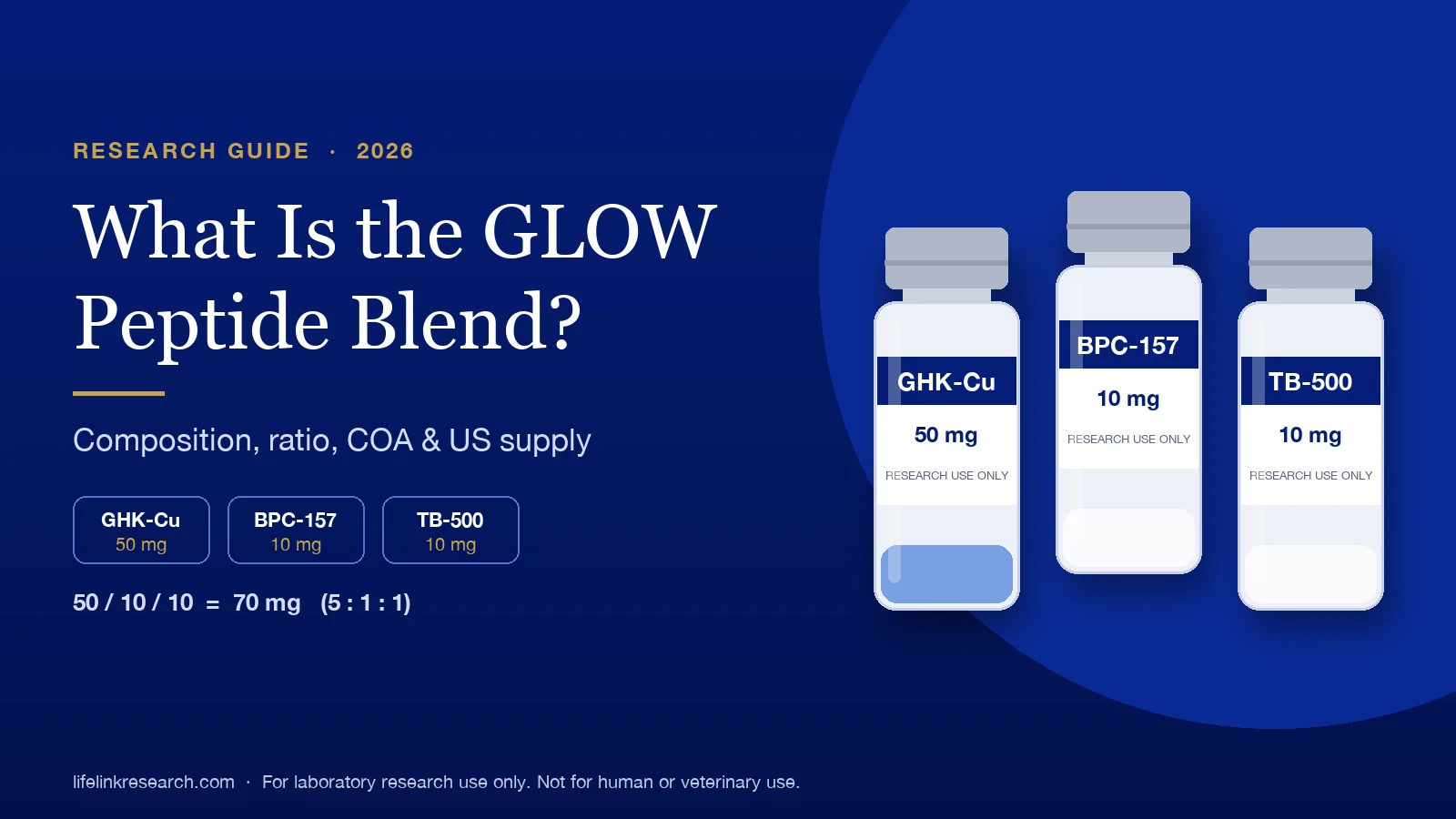
GLOW is a 70mg research peptide combination of GHK-Cu 50mg, BPC-157 10mg and TB-500 10mg, a 5:1:1 ratio in which GHK-Cu is about 71% of the mass. “GLOW” is an informal market name, not a brand or an approved product, and it is supplied for laboratory research only.
Key Takeaways
- GLOW is GHK-Cu, BPC-157 and TB-500 in one product.
- The ratio is 50/10/10 (5:1:1), for 70mg in total.
- KLOW is GLOW plus KPV.
- A GLOW COA has to confirm all three compounds.
- Compare price per mg of verified compound, never price per vial.
Search “GLOW peptide” and the results page shows why the name confuses people. Clinic ads, skincare brands, a vendor that borrowed the name and a carousel of shopping listings all compete for the same five letters.
This guide sets the marketing aside. It explains what the GLOW peptide blend contains, what the numbers on the label mean, how to check a certificate for a three-part product, and what GLOW costs per milligram from US suppliers. The audience is researchers buying laboratory reagents labeled research use only, and a primer on how peptides are researched is a good place to start if the category is new to you.
In this guide
- What GLOW is
- Contents of the blend
- The three components
- Where the name comes from
- Why the ratio is 5:1:1
- GLOW vs GHK-Cu alone
- GLOW vs KLOW and NAD+
- Why GLOW is blue
- Single vial or three-vial kit
- Limitations
- Checking a GLOW COA
- Legal status
- Storage
- Cost and US supply
- FAQs
What Is GLOW Peptide?
Quick answer: GLOW peptide is a market name for three research peptides combined: GHK-Cu, BPC-157 and TB-500. It is sold as “GLOW blend”, “GLOW 70” or “GLOW stack”. It is unrelated to skincare products or companies that use “Glow” in their name.
Search results mix three very different things under one word. There’s the peptide combination this guide covers, there are cosmetic lines with “glow” in the product name, and there are businesses that have adopted the word as a brand. Only the first one is a research reagent.
Within the research market, the combination turns up under three labels:
- GLOW blend: the three peptides lyophilized into one powder in a single vial.
- GLOW 70: the same blend, named for its 70mg total.
- GLOW stack: the three compounds packed as individual vials inside a kit.
Sellers don’t use these labels consistently. Before comparing two listings, read the line that states what’s inside and how many vials you’ll receive.
A research listing is also easy to tell apart from a cosmetic one. It names each compound with its amount, lists CAS numbers and test methods, and carries a research-use-only statement. A product page built around a lifestyle photo and a single brand name is selling something else.
What Is in the GLOW Peptide Blend?
Quick answer: GLOW contains GHK-Cu (50mg), BPC-157 (10mg) and TB-500 (10mg), for 70mg in total. GHK-Cu makes up about 71.4% of the mass and the other two about 14.3% each, which is why the ratio is written 5:1:1.
Values in the table match the specification sheets on Life Link’s product pages.
| Component | mg | % of mass | Sequence | Molecular weight | CAS |
| GHK-Cu | 50 | 71.4% | Gly-His-Lys with bound Cu(II) | 404 g/mol (complex) | 89030-95-5 |
| BPC-157 | 10 | 14.3% | GEPPPGKPADDAGLV | 1,419.5 g/mol | 137525-51-0 |
| TB-500 | 10 | 14.3% | Full-length thymosin beta-4, 43 residues | 4,963.55 Da | 77591-33-4 |
The “70mg” on a GLOW label is a total, and it describes the combined weight of three different molecules. You don’t get 70mg of any single compound. You get 50mg of one and 10mg each of the other two, so the useful number for any one compound is its own line in the table.
Measured amounts on a certificate can also come in slightly above or below the label, because labs report what’s in the vial, which includes normal fill variation. A good report shows each compound’s figure separately, so you can see where any difference comes from.
GLOW peptide blend ratio 5:1:1
What Is Each Component of GLOW?
Quick answer: GHK-Cu is a copper-binding tripeptide, BPC-157 is a 15-amino-acid synthetic peptide, and TB-500 here is full-length thymosin beta-4. Each is studied separately, mostly in cell and animal models.
The three compounds come from unrelated corners of the literature. Each has its own synthesis, its own analytical profile and its own research history, which is why each needs its own check.
GHK-Cu (50mg)
GHK-Cu is glycine, histidine and lysine, three amino acids long, carrying one copper(II) ion. The metal is held in a pocket formed mostly by nitrogen atoms from the peptide, and that complex is the material in the vial.
Computational chemists have tested how firmly it holds on. Alshammari and Platts reported in 2020 that a “molecular dynamics simulation of Cu-GHK shows the stability of the copper-peptide binding”, with four bonds staying in place throughout the run (Computational Biology and Chemistry). Most other GHK-Cu work uses cultured cells. Specifications for the vial are on the GHK-Cu 50mg product page.
BPC-157 (10mg)
BPC-157 is a synthetic pentadecapeptide, meaning 15 amino acids: Gly-Glu-Pro-Pro-Pro-Gly-Lys-Pro-Ala-Asp-Asp-Ala-Gly-Leu-Val. Its sequence comes from a gastric protein, and the bulk of its published research uses rodent models.
Interest in it has grown well beyond journals. A 2025 literature and patent review in Pharmaceuticals points to “recent interest in BPC 157 as reflected in a number of patent applications and granted patents” (Józwiak et al., 2025). The BPC-157 10mg product page lists its full specification.
TB-500 (10mg)
TB-500 is the trickiest name in GLOW, because sellers attach it to two different molecules. One is Ac-LKKTETQ, a short acetylated stretch of seven amino acids. The other is the complete thymosin beta-4 protein of 43 residues, and CAS 77591-33-4 belongs to that complete protein.
Life Link’s TB-500 is the complete protein at 4,963.55 Da, and the Prodigy Labs report issued in September 2026 names it as such. Research on thymosin beta-4 relies mainly on cultured cells and animal models, with much of the attention on how it binds actin. Full details are on the TB-500 10mg page.
Why Is It Called GLOW?
Quick answer: “GLOW” is an informal name, chosen for GHK-Cu’s long history in cosmetic chemistry. It names a common combination, not a product claim, and suppliers use it for different amounts, so always check the label and COA.
No lab or manufacturer coined the term in a paper. It spread through vendor listings and forum threads, and its later cousin KLOW followed the same route. A catchy name helps people find a product. It tells you nothing about what’s inside a particular vial.
That is the reason to read past the name every time. Two products called GLOW can differ in total milligrams, in which TB-500 they use and in whether they arrive blended or as separate vials. The ingredient line and the lab report settle those questions in seconds.
Why Is the GLOW Ratio 5:1:1?
Quick answer: The 5:1:1 ratio is a supplier convention that weights GLOW toward GHK-Cu. It is not a formula validated in published research. Some vials use different amounts, so check that the label reads 50/10/10 before you compare products.
The pattern follows the way each compound is commonly sold on its own. GHK-Cu typically comes in 50mg vials, while BPC-157 and TB-500 are standard at 10mg. Putting one of each together produces 50/10/10 without any further design step.
Weight and molecule count tell different stories here. GHK-Cu is the lightest of the three molecules, so 50mg of it represents a much bigger head count than the 71.4% figure implies. TB-500, at almost 5,000 Da, adds 10mg by weight and only a small share of the molecules.
That’s why the label figure on its own can mislead. A vial reading “GLOW 70mg” with 5:1:1 on the side is the standard product, while a vial with a different total or a ratio left off needs a closer look at the certificate before you treat it as equivalent.
The ratio also works as a check on the paperwork. A blended certificate should report three measured amounts near 50, 10 and 10. With separate vials, each report should show its compound close to its own label. A result far from those numbers points to a fill or synthesis problem the label would never reveal.
GLOW vs GHK-Cu Alone: What’s the Difference?
Quick answer: A 70mg GLOW vial holds the same 50mg of GHK-Cu as a standalone GHK-Cu vial, plus 10mg each of BPC-157 and TB-500. GLOW adds two compounds, which means more variables in a study and more identities to verify.
“Is GLOW better than GHK?” is one of the most common questions in this search. Both products carry the same 50mg of GHK-Cu. What changes is everything around it.
| GHK-Cu alone | GLOW | |
| Compounds | 1 | 3 |
| Total mg | 50 | 70 |
| GHK-Cu share of mass | 100% | 71.4% |
| Compounds to verify | 1 | 3 |
| Typical format | Single vial | Blended vial or three-vial kit |
For a study, every added compound is another variable. If a result shows up with GLOW, it could come from any of the three, or from the way they behave together, and separating those takes extra controls.
The paperwork scales the same way. One GHK-Cu vial calls for a single purity result and a single identity check, and GLOW calls for three of each. A single-compound design asks less of your verification and your data analysis, while GLOW suits a study built to look at three compounds side by side.
Cost follows the same logic. Life Link’s GHK-Cu 50mg vial is $64, or $1.28 per mg, and every milligram is the compound under study. In GLOW, the GHK-Cu still accounts for 50mg, and the other 20mg buys two additional compounds that a GHK-Cu-only study wouldn’t use.
How Does GLOW Compare With KLOW and NAD+?
Quick answer: KLOW is GLOW plus 10mg KPV (80mg in total). NAD+ is a coenzyme involved in cellular energy metabolism, not a peptide, and it is grouped with GLOW mainly in marketing. Wolverine is BPC-157 plus TB-500 without GHK-Cu.
| Product | Contents | Total | Type |
| Wolverine | BPC-157 + TB-500 | 20 mg | Peptide combination |
| GLOW | GHK-Cu + BPC-157 + TB-500 | 70 mg | Peptide combination |
| KLOW | GLOW + KPV | 80 mg | Peptide combination |
| NAD+ | Nicotinamide adenine dinucleotide | Sold separately | Coenzyme |
The three peptide products nest inside each other. Wolverine is the core, GLOW adds GHK-Cu, and KLOW adds KPV on top. The full KLOW vs GLOW comparison covers that step in detail, and the Wolverine kit, with BPC-157 and TB-500 only, is the smallest member of the family.
NAD+ belongs to a different chemical class altogether. PubChem describes it as a coenzyme “involved in numerous enzymatic reactions in which it serves as an electron carrier.” Its molecule is a dinucleotide with no amino acids at all. The NAD+ 500mg listing states that directly in its specification.
The grouping comes from retail shelves. Peptide vendors sell NAD+ alongside their blends, and some advertise them as a set. In the lab they share almost nothing: NAD+ weighs 663.43 g/mol, carries no copper, and is studied as part of cellular redox chemistry.
GLOW KLOW Wolverine and NAD+ compared
Why Is GLOW Blue?
Quick answer: The blue color comes from the copper(II) in GHK-Cu. It is expected and not a sign of contamination; a GLOW sample with no blue tint may lack GHK-Cu.
Copper(II) complexes absorb light toward the red end of the spectrum and pass the blue end through, so the material reads as blue. The GHK-Cu spec sheet describes the powder as a “blue to blue-violet solid.” BPC-157 and TB-500 arrive as white or off-white powders.
The tint is also a handy label check on a kit. In a three-vial GLOW set, only the GHK-Cu vial should look blue, which makes it easy to tell the vials apart even before you read the labels.
Treat the color as a quick first look. It shows copper is present, and only the certificate can show how much GHK-Cu there is and whether BPC-157 and TB-500 are in the vial too.
Single-Vial GLOW Blend or a Three-Vial Kit: Which Should You Buy?
Quick answer: A single GLOW vial is convenient but fixes the ratio, and one COA must confirm three compounds in one mixture. A three-vial kit lets you verify each compound separately, prepare each on its own, and avoid storing copper with other peptides. Kits cost more per mg.
| Factor | Single vial | Three vials |
| Verification | One report has to resolve three compounds | One report per compound |
| Flexibility | 50/10/10 only | Any ratio a study needs |
| Stability unknowns | Copper stored alongside two other peptides | Each powder kept apart |
| Storage | One vial | Three vials to label and track |
| Price per mg | Lower | Higher |
The single vial’s appeal is simplicity: one item to order, label and store. The tradeoff shows up at verification. HPLC (high-performance liquid chromatography) has to separate three compounds in one sample, and the report has to give each its own result for the certificate to be useful.
Storage is the open scientific question. Stability studies of GHK-Cu stored with BPC-157 and TB-500 are scarce, and copper complexes can interact with other molecules over time. Separate vials keep each dry powder on its own until a study needs it.
The same reasoning drives the comparison of lyophilized vs pre-mixed peptides: fewer things in contact means fewer unknowns. Lyophilized means freeze-dried, a dry form that keeps far better than any liquid.
What Are the Limitations of GLOW?
Quick answer: GLOW’s main research limitations are that no published study has tested the three-compound combination, blended vials are harder to verify, amounts vary between suppliers, and none of the components is FDA-approved for human use.
Those four limitations, in order:
- No study of the combination. Each compound has its own papers, and none tests all three together.
- Harder verification. A blended vial needs a certificate that resolves three compounds in one sample.
- Inconsistent amounts. The name isn’t standardized, so totals and ratios differ between suppliers.
- No approval. None of the three is an FDA-approved drug, so all are supplied for laboratory research only.
None of these limitations is unusual for a research reagent. They’re the normal state of a product name that grew up in the market before anyone studied it as a unit. Knowing them in advance helps a study plan its controls and its verification.
The first limitation shapes how to read anything written about GLOW. Claims about the combination usually come from stacking findings for each compound, and those findings came from separate studies with separate models.
How Do You Check a GLOW COA?
Quick answer: Check that all three compounds are named, confirm each identity by mass spec, check the purity of each by HPLC, match the batch number to your vial, and verify the report with the testing lab.
- Check all three compounds are named.
- Confirm each identity by mass spec.
- Check the purity of each by HPLC.
- Match the batch number to your vial.
- Verify the report with the testing lab.
A COA (Certificate of Analysis) is the testing lab’s report on one production batch. HPLC measures purity by separating the sample into peaks. ESI-MS (electrospray ionization mass spectrometry) confirms identity by measuring each molecule’s mass against the expected value. Our explainer on HPLC vs mass spectrometry shows what each method can and can’t tell you.
A blended GLOW certificate is only useful if it breaks the result down. One line reading “GLOW 70mg: 99%” leaves you guessing which compound that figure belongs to. Look for three named compounds, each with its own purity figure.
With a kit, each vial has its own report. For Life Link’s GLOW components, the current certificates come from two independent labs: Janoshik Analytical for GHK-Cu and BPC-157, and Prodigy Labs, based in San Diego, for TB-500. Every report gives a purity figure for one compound only.
A kit also means three batch numbers, and the three compounds may have been made and tested at different times. That’s expected. What you want is a current report for every vial, matched by batch number.
For context on those numbers, read what 98% vs 99% purity means.
GLOW peptide COA example
| Field on the TB-500 report | What to check |
| Report no. PL-COA-20260929-BF19-R4 | The record the lab can confirm |
| Sample: TB-500 (Thymosin Beta-4) 10mg | One compound, named on its own |
| Peptide purity (HPLC): >99.5% | Clears the 99% standard |
| Analysis completed: Sept 22, 2026 | Shows the report is recent |
| Scan to verify | Confirms the report with Prodigy Labs |
Do You Need a Prescription for GLOW Peptide? Is It Legal?
Quick answer: GLOW is not an FDA-approved drug, so no prescription version exists. Its components are sold as research reagents for laboratory use only. In 2026 the FDA removed GHK-Cu from its Category 2 list, and an advisory panel backed BPC-157 and TB-500 for compounding; neither step approves GLOW.
Category 2 is the FDA’s list of substances it has flagged as risky for pharmacy compounding. In April 2026 it took 12 peptides off that list, GHK-Cu among them, which moves them back into the normal review process.
In July, the FDA’s Pharmacy Compounding Advisory Committee reviewed seven peptides over two days. BPC-157 and TB-500 were both recommended for the 503A list, which governs what compounding pharmacies may use. GHK-Cu wasn’t on that agenda.
Those two decisions moved the components in different directions on the calendar. BPC-157 and TB-500 now wait on FDA rulemaking, a process with no fixed end date, while GHK-Cu still waits for its committee review.
Neither step approves GLOW or any product containing it. A recommendation goes to the FDA for rulemaking, and research reagents remain laboratory materials throughout. Our summary of the peptides the FDA reviewed in 2026 walks through each vote.
How Should GLOW Be Stored?
Quick answer: Keep lyophilized GLOW at -20°C, away from light and moisture. Let each vial reach room temperature before opening, and avoid repeated freeze-thaw cycles.
A cold vial opened too soon collects condensation, and moisture is the main threat to a dry powder. With a three-vial kit, keep the vials together in one labeled box with their batch numbers noted. Keep the lab reports in the same place, so pairing a vial with its paperwork takes seconds. Our guide to storage and handling covers freezers, light and labeling in more depth.
How Much Does GLOW 70mg Cost, and Where Can You Buy It in the US?
Quick answer: US suppliers list GLOW 70mg at roughly $49 to $158 per vial (October 2026), about $0.70 to $2.25 per mg. A legit supplier ships from US stock, publishes a COA confirming all three compounds, and states whether it sells a blended vial or separate vials.
| Format | Typical price (October 2026) | Price per mg | What you get |
| Single blended 70mg vial | $49 to $158 | $0.70 to $2.25 | One vial, usually a single combined COA figure |
| Life Link GLOW | $197 | About $2.81 | Three separate vials with a report for each |
| Three single vials (Life Link) | $299 | About $4.27 | The same three compounds, priced individually |
Is GLOW peptide legit? The product type is, as a research reagent. Whether a given listing is legit depends on the seller: a registered business, US stock, and a certificate that names all three compounds with separate results. A low price with a single combined purity line is the listing to question.
The TB-500 version also affects value. Two vials labeled “TB-500 10mg” may hold different molecules, the short Ac-LKKTETQ fragment or complete thymosin beta-4, which differ greatly in size. Ask which one a supplier uses before you compare prices.
The Life Link GLOW kit ships the three compounds as separate vials from US stock, and the full range of research kits follows the same format. For the checks to run on any seller, see how to choose a US peptide supplier.
GLOW Peptide FAQs
What is in GLOW peptide?
GLOW contains three research peptides: GHK-Cu (50mg), BPC-157 (10mg) and TB-500 (10mg), for 70mg in total. GHK-Cu makes up about 71.4% of the mass and the other two about 14.3% each. It’s sold either as one blended vial or as three separate vials in a kit.
What does “70mg” on a GLOW vial mean?
The 70mg figure is the combined weight of all three compounds in the product. It breaks down as 50mg of GHK-Cu and 10mg each of BPC-157 and TB-500. For any single compound, read its own line on the label or certificate.
Is GLOW better than GHK-Cu?
GLOW and a GHK-Cu vial contain the same 50mg of GHK-Cu. GLOW adds 10mg each of BPC-157 and TB-500, which gives a study two more variables and two more identities to verify. The right choice depends on whether the research design needs one compound or three.
Is GLOW peptide legit?
GLOW is a legitimate research reagent category, sold for laboratory use only. A specific listing is trustworthy when the seller is a registered US business, ships from US stock, and publishes a certificate naming all three compounds with separate purity results. A single combined percentage is a weak sign.
Is GLOW legal in the US?
In the US, GLOW’s three components are supplied as laboratory research reagents, and the FDA has approved none of them as a drug. The 2026 Category 2 change for GHK-Cu and the advisory vote on BPC-157 and TB-500 don’t approve any product. See BPC-157 legal status for how that works for one component.
Can you buy GLOW components separately?
Yes, GHK-Cu, BPC-157 and TB-500 are each sold as separate vials. Buying them apart gives a study control over the ratio and a separate lab report for each compound. The component pages linked in this guide list full specifications for each one.
⏱ GLOW in 30 seconds
GLOW is 70mg of three research peptides: GHK-Cu 50mg, BPC-157 10mg and TB-500 10mg, a 50/10/10 (5:1:1) ratio with GHK-Cu at 71.4% of the mass. KLOW is the same plus KPV. Make sure the COA names all three compounds, and judge price by the milligrams the certificates confirm.
Research use only. GLOW, GHK-Cu, BPC-157 and TB-500 are laboratory reagents intended for qualified researchers working in vitro. None carries FDA approval, and none is meant for use in people or animals, or in diagnosis or therapy. This guide offers no medical advice.
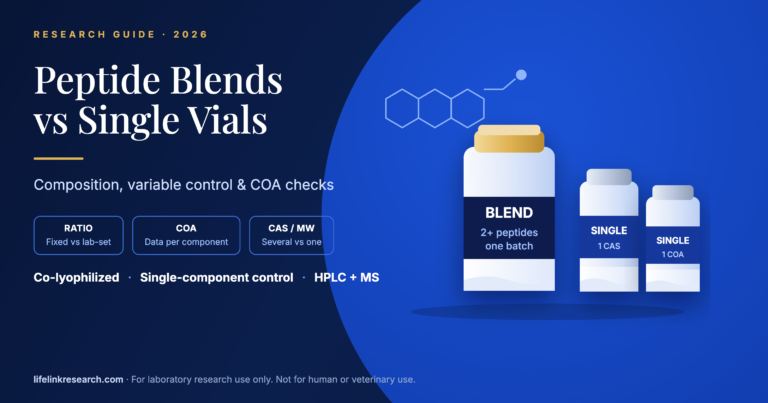
Peptide Blends vs Single Vials: How to Choose for Research (2026)
For Research Use Only. Not for use in diagnostic or therapeutic procedures. Choosing between peptide blends vs single peptides comes down to…
Read article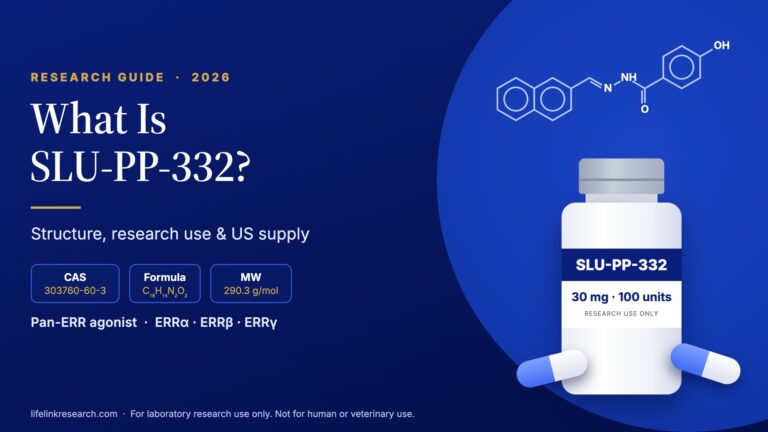
What Is SLU-PP-332? Structure, Research Use & US Supply
Quick Answer SLU-PP-332 is a synthetic small-molecule agonist of the estrogen-related receptors ERRŒ±, ERRŒ≤ and ERRŒ≥ (CAS 303760-60-3, PubChem CID 5338394). It…
Read article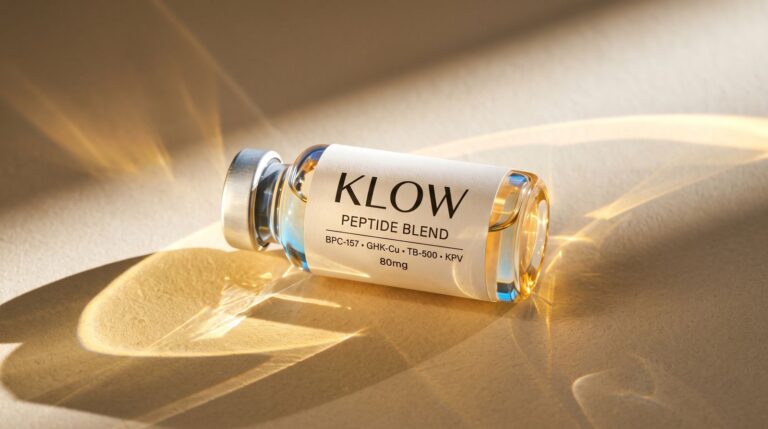
What Is the KLOW Peptide Blend? Composition, Ratio, COA & US Supply
Quick Answer KLOW is an 80mg research peptide combination of GHK-Cu 50mg, BPC-157 10mg, TB-500 10mg and KPV 10mg, a 50/10/10/10 ratio.…
Read articleResearch-grade peptides
99%+ purity. Verified every batch.
Identity and purity tested on every batch by third-party labs, Janoshik Analytical and US-based laboratories. Shipped same day from California.
Shop all peptides