

Quick answer: As of August 2026, BPC-157 is not an FDA-approved drug, not a legal dietary supplement, and not yet approved for pharmacy compounding. An FDA advisory committee voted 8-6 in July 2026 to recommend it for the 503A compounding list, but that vote is non-binding and formal rules are still months away. For now, it stays research-use-only.
BPC-157 Legality in 2026
“Is BPC-157 legal?” sounds like a yes-or-no question, and the truthful answer has a few layers. The molecule belongs in different boxes depending on who’s asking: the FDA, a compounding pharmacy, a supplement retailer, or an anti-doping agency each see it differently. The picture also changed twice in 2026, which is where a lot of the confusion comes from. Here’s where each piece actually stands.
This page is regulatory information and general commentary, not legal, medical, or purchasing advice. BPC-157 referenced here is for in-vitro laboratory research only, not for human or veterinary use.
| BPC-157 status, five ways | Where it stands |
| FDA-approved drug | No |
| Legal dietary supplement | No |
| 503A pharmacy compounding | Recommended in July 2026, pending rulemaking |
| Allowed in competitive sport (WADA) | Prohibited (S0) |
| Research use only | Yes, this is the lane it’s sold in |
What BPC-157 Is
BPC-157 is a synthetic peptide, a lab-made chain of amino acids based on a sequence found in a protein in gastric juice. Understanding how peptides are built helps here, because BPC-157 is studied for the same reasons many peptides are: it shows up frequently in preclinical tissue-repair and gut research. The science is interesting and still early, which is the backdrop to every regulatory question that follows.
A majority of that evidence comes from cell cultures and animal models, with human clinical data still limited. That research stage is worth keeping in mind, because it’s the reason regulators have moved cautiously and the reason the compound continues to sit in a research setting rather than a pharmacy shelf.
The Two Regulatory Shifts of 2026
Two separate events changed BPC-157’s status in 2026, and mixing them up is the single most common mistake in coverage of this topic. They’re related, yet they do very different things.
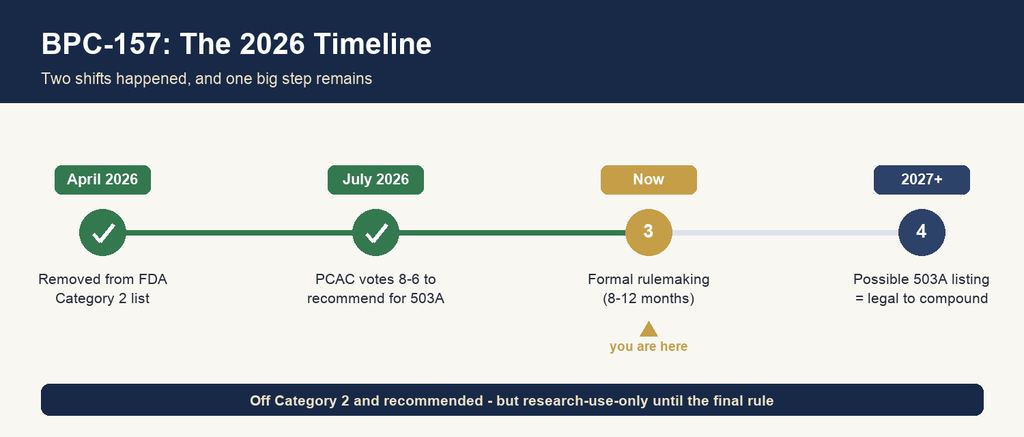
The first change came in April 2026, when the FDA removed BPC-157 from its Category 2 bulk-substances list. Category 2 flagged substances with significant safety questions, and being on it effectively kept compounding pharmacies away. Coming off that list cleared one obstacle, though it did not, on its own, make BPC-157 legal to compound.
The second change came at the July 23 and 24 meeting of the FDA’s Pharmacy Compounding Advisory Committee. The panel voted 8-6 to recommend adding BPC-157 to the 503A Bulks List, tied to a proposed ulcerative colitis indication, and it did so over the objection of FDA staff. That recommendation belongs to a wider review of seven peptides the committee took up across those two days.
So Is BPC-157 Legal in 2026?
The clean answer is that BPC-157 has no approved legal use for humans right now, and a committee vote hasn’t changed that. It helps to take the question one box at a time.
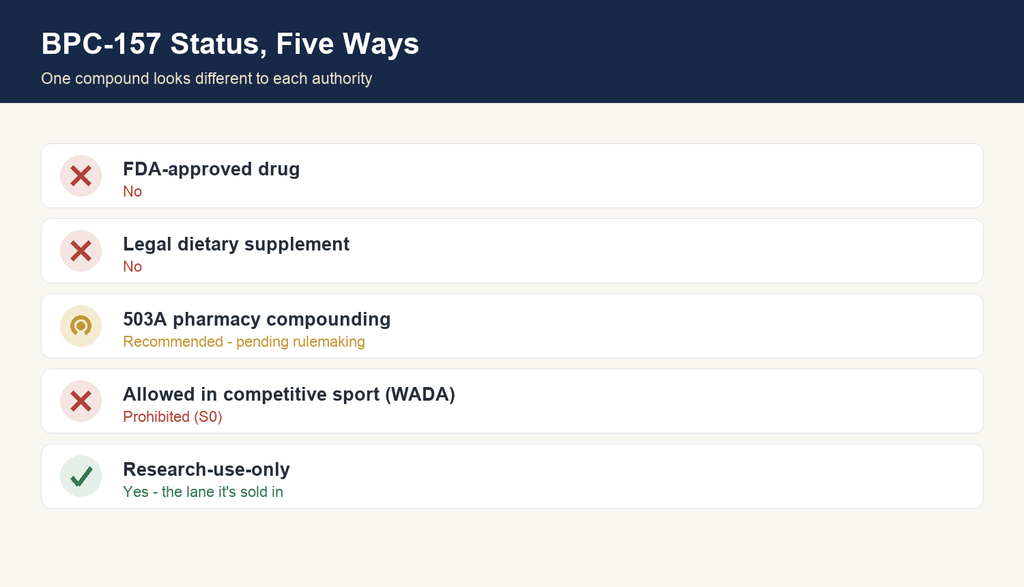
- As a drug, it has never been FDA-approved for treating any condition.
- As a dietary supplement, it doesn’t qualify either, since regulators treat BPC-157 as an unapproved drug that isn’t a lawful dietary ingredient, which means it can’t be sold over the counter as a supplement.
- As a compounding ingredient, it’s recommended but pending, because the July vote guides the FDA without binding it.
The difference between a recommendation and a rule is where the timeline lives. As regulatory attorney Dustin Robinson of LumaLex Law put it, “the advisory committee’s recommendation still triggers a formal rulemaking cycle that realistically runs eight to twelve months before 503A pharmacies have unambiguous legal authority to compound these substances.” Until that cycle finishes, the honest status is research-use-only.
BPC-157 and Sport: The WADA Line
Athletes have their own version of this question, and the answer there is clear-cut. The World Anti-Doping Agency prohibits BPC-157 at all times under category S0, which covers substances that no health authority has approved for human use. Because BPC-157 fits that description, it’s banned in competitive sport regardless of any FDA compounding decision.
One detail catches people off guard: enforcement can be non-analytical, meaning an athlete can be sanctioned on evidence like admissions or possession, without a positive drug test. The prohibition also reaches U.S. military members under strict-liability rules. WADA’s list moves on its own track, so a future 503A listing wouldn’t lift the sporting ban.
What “Research Use Only” Means
Research-use-only is the label that ties all of this together, and it’s a real legal category. It means BPC-157 is supplied for in-vitro laboratory study, and it carries no clearance for human consumption, self-administration, or clinical use. The designation is about what the compound can be sold and used for, and it holds no matter which way the FDA’s compounding decision eventually goes.
For a lab, that framing is a feature. It sets clear expectations, keeps the work inside the bounds of the law, and puts the focus where it belongs, on the quality and documentation of the material itself.
What’s Next
The story isn’t finished. The FDA still has to run its rulemaking, HHS Secretary Robert F. Kennedy Jr. has a role in approving any addition to the bulk list, and more peptides are queued for advisory review before February 2027. BPC-157 traveled a similar road to peptides like the KPV tripeptide, which cleared the same July vote, while others such as TB-500 and MOTS-c sit at their own points in the process. Anyone tracking BPC-157 closely will be watching the Federal Register, where a proposed rule would appear first.
Why Verified Quality is Still Crucial
Regulatory status tells you what a compound is allowed to be. The contents of the vial on your bench are a separate question, and that one a lab can actually control. Two tests carry the load here. Mass spectrometry and HPLC together handle confirming a peptide’s identity and purity, answering whether the material is truly BPC-157 and how much of the sample is the peptide versus everything else.
The purity figure deserves a second look, since what a purity percentage really tells you is how much of the vial isn’t your target compound. Those numbers belong on a Certificate of Analysis, and learning to make sense of a Certificate of Analysis is what lets you hold a supplier to its claims.
We attach paperwork to each batch we make and stand it on the full screen we run on every lot, which covers the safety measures a purity reading alone won’t tell you. Whatever the rules become, that verification is the constant.
Frequently Asked Questions
Is BPC-157 FDA approved?
No. BPC-157 has never been approved by the FDA as a drug for treating any condition. In July 2026 an advisory committee recommended it for the 503A compounding list, but a recommendation is not an approval, and it remains an unapproved substance under ongoing federal review.
Can you legally buy BPC-157 in 2026?
BPC-157 is sold in the United States as a research-use-only compound for in-vitro laboratory work. It cannot be legally marketed as a dietary supplement or as a drug for human use, and no committee vote has changed that.
Is BPC-157 a dietary supplement?
No. Regulators treat BPC-157 as an unapproved drug that doesn’t qualify as a lawful dietary ingredient, so it can’t be sold over the counter as a supplement. That status is separate from the FDA’s compounding review.
Is BPC-157 banned in sports?
Yes. WADA prohibits BPC-157 at all times under its S0 category for non-approved substances. Enforcement can be non-analytical, meaning a sanction can rest on evidence like possession, and the prohibition also reaches U.S. military members.
Are peptides legal in 2026 more broadly?
It depends entirely on the peptide and the use. A handful earned favorable compounding recommendations in July 2026, some are approved drugs in their own right, and many remain research-use-only. There’s no single rule that covers all peptides at once.
What’s the latest news on BPC-157?
The two developments driving 2026 coverage are its April removal from the FDA’s Category 2 list and the July 8-6 advisory vote recommending it for 503A compounding. Both matter, yet neither makes it an approved product, and formal rulemaking is the next milestone to watch.
Does the July 2026 vote make BPC-157 legal to compound?
Not yet. The 8-6 vote was a non-binding recommendation. The FDA still has to complete formal rulemaking, a process one regulatory attorney estimated at eight to twelve months, before pharmacies would have clear authority to compound it.
What does the Category 2 removal mean?
In April 2026 the FDA took BPC-157 off its Category 2 bulk-substances list, which had flagged safety concerns and blocked compounding. Removal cleared one hurdle, but it’s a separate step from being added to the 503A list that would allow compounding.
The Bottom Line
BPC-157 in 2026 is a compound in motion, and its legal picture is easy to overstate in either direction. It came off the Category 2 list, earned a favorable compounding recommendation, and drew real regulatory attention, yet it remains an unapproved drug, an unlawful supplement, a substance banned in sport, and a research-use-only material until formal rules say otherwise.
For anyone working with it in that research setting, the quality of what’s in the vial and solid paperwork behind it are most important while the rules catch up.
Research use only. BPC-157 referenced here is for in-vitro laboratory research only, not for human or veterinary use, diagnosis, treatment, or consumption. This page is general regulatory commentary and not legal advice. The claims made here have not been assessed by the US Food and Drug Administration.
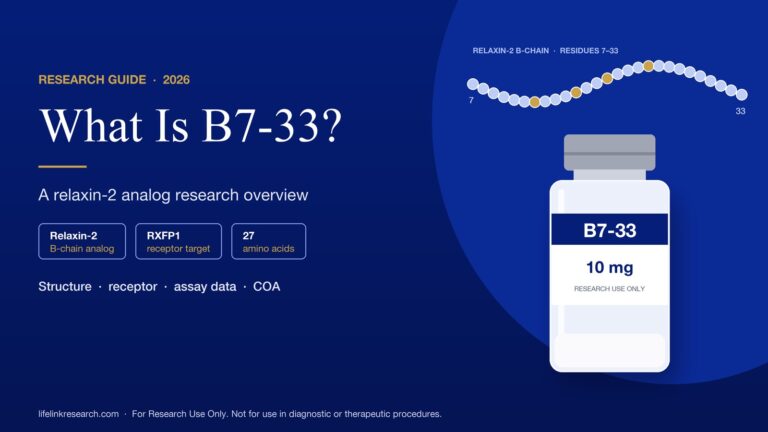
What Is B7-33? Relaxin-2 Analog Research Overview (2026)
Quick Answer B7-33 is a synthetic single-chain peptide built from part of the B chain of human relaxin-2, and it binds the…
Read article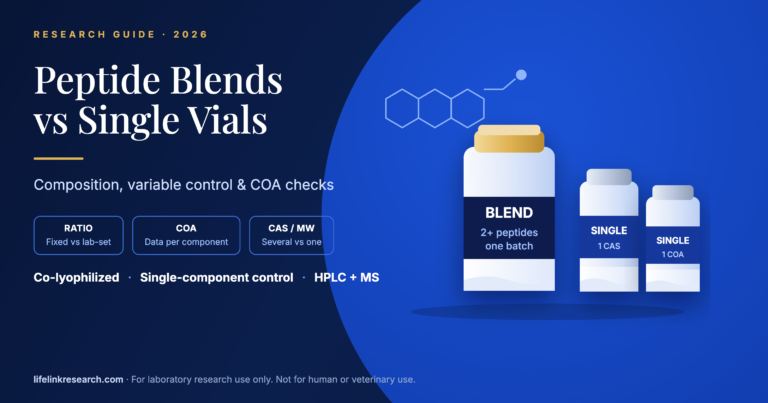
Peptide Blends vs Single Vials: How to Choose for Research (2026)
For Research Use Only. Not for use in diagnostic or therapeutic procedures. Choosing between peptide blends vs single peptides comes down to…
Read article
What Is SLU-PP-332? Structure, Research Use & US Supply
Quick Answer SLU-PP-332 is a synthetic small-molecule agonist of the estrogen-related receptors ERRŒ±, ERRŒ≤ and ERRŒ≥ (CAS 303760-60-3, PubChem CID 5338394). It…
Read articleResearch-grade peptides
99%+ purity. Verified every batch.
Identity and purity tested on every batch by third-party labs, Janoshik Analytical and US-based laboratories. Shipped same day from California.
Shop all peptides