
Quick Answer
Two vials can both say CagriSema 10mg and contain different amounts of peptide. CagriSema is the name used for two separate peptides, Cagrilintide and Semaglutide, supplied together in one vial for laboratory research. Inside that vial, there are two molecules, each with its own sequence, its own mass, and its own receptor target. So the paperwork behaves differently from a single-compound vial, and one number on a label can mean two very different things.
A peptide blend and a single-compound vial get checked in different ways, and that difference is what this page is about. Below you will find what each peptide is, how to identify both, and how to read a certificate of analysis that has to cover two compounds at once.
For Research Use Only. Not for use in diagnostic or therapeutic procedures.
What Is CagriSema?
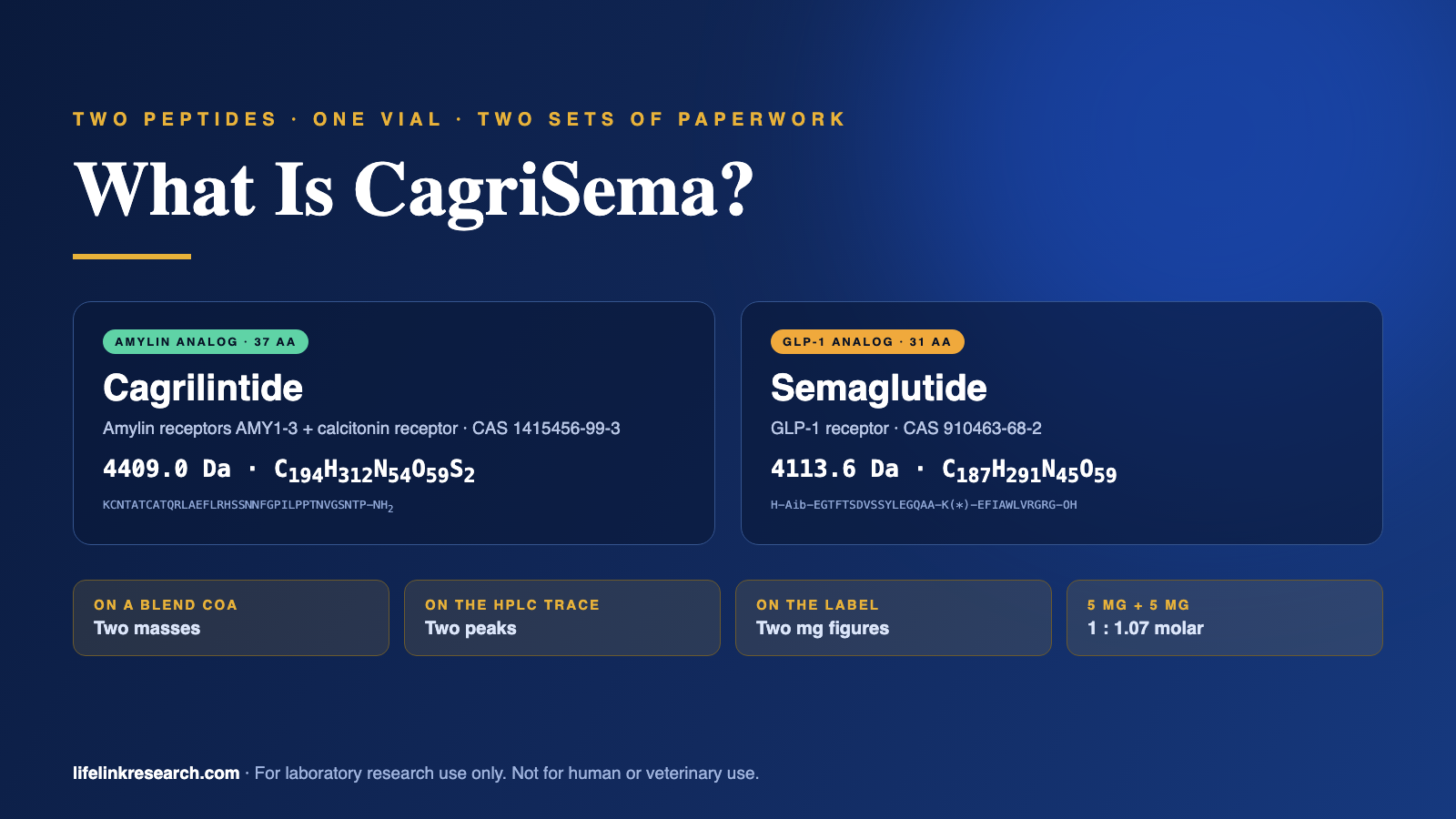
Quick answer: CagriSema is a combination of two peptides, Cagrilintide, an amylin-receptor agonist, and Semaglutide, a GLP-1 receptor agonist, supplied as one lyophilized blend. They are two molecules sitting in the same vial. Each keeps its own sequence, mass, and receptor target, so a blend vial needs a separate identity and purity result for each peptide.
The name itself comes from the drug developer. Novo Nordisk uses CagriSema for its combination of the two, describing it on 14 November 2026 as “an investigational fixed-dose combination of a long-acting amylin analog, Cagrilintide, and the GLP-1 receptor agonist, Semaglutide”.
That distinction is worth a second, because a research vial and a fixed-dose combination are built differently. A fixed-dose product is co-formulated at set amounts per injection. A research vial is simply the two peptides dried together, usually at a stated milligram amount each, and it is on you to confirm both are present at the amounts the label claims.
What Is in a CagriSema Vial? Identifier Table
A CagriSema vial contains Cagrilintide and Semaglutide as separate, intact molecules. Each one has its own formula, molecular weight, CAS number, and UNII code, and those identifiers are what a mass-spectrometry result on a certificate of analysis gets compared against. The table below gives both sets, verified against PubChem.
| Cagrilintide | Semaglutide | |
| Type | Amylin analog, 37 amino acids | GLP-1(7-37) analog, 31 amino acids |
| Sequence | KCNTATCATQRLAEFLRHSSNNFGPILPPTNVGSNTP-NH2 | H-Aib-EGTFTSDVSSYLEGQAA-K(\\*)-EFIAWLVRGRG-OH |
| Formula | C194H312N54O59S2 | C187H291N45O59 |
| MW, average/monoisotopic | 4409.0 / 4406.25 | 4113.6 / 4111.12 |
| CAS | 1415456-99-3 | 910463-68-2 |
| PubChem CID | 171397054 | 56843331 |
| UNII | AO43BIF1U8 | 53AXN4NNHX |
| Lipidation | N-terminal C20 diacid, via gamma-Glu | Lys26, gamma-Glu plus 2x OEG plus C18 diacid (\\*) |
| Receptor target | Amylin receptors AMY1 to AMY3, calcitonin receptor | GLP-1 receptor |
The two average masses, 4409.0 and 4113.6, are the numbers to memorise. They are about 295 daltons apart, wide enough that any mass spectrometer worth the name separates them cleanly. If a report shows one mass where there should be two, something is wrong with either the vial or the method.
How Do Cagrilintide and Semaglutide Differ in Structure?
Both peptides use the same trick: a fatty-diacid chain bolted onto the backbone. Everything else differs: parent hormone, length, attachment point, and chain.
Cagrilintide Backbone
Cagrilintide is built on the human amylin sequence, with six changes to the original: N14E, V17R, A25P, S28P, S29P and Y37P. A disulfide bridge links Cys2 and Cys7, forming the small ring near the front end that amylin-family peptides share, and the C-terminus is an amide rather than a free acid. PubChem records that bridge as a cyclic 3-to-8 disulfide, counting the gamma-Glu as residue one. Those six substitutions are what separate the Cagrilintide structure and sequence from native human amylin.
Semaglutide Backbone
Three changes separate Semaglutide from native GLP-1(7-37): Aib at position 8 in place of Ala, Arg at position 34 in place of Lys, and a fatty chain hung off Lys26. The C-terminus stays a free acid.
Two Different Fatty-Diacid Chains
The chains are where the two peptides part company on an HPLC trace. Cagrilintide carries a C20 diacid joined through a single gamma-Glu at the N-terminus. Semaglutide carries a shorter C18 diacid, joined through gamma-Glu and two OEG spacer units, at Lys26 in the middle of the chain. Longer chain, more hydrophobic, later elution. That difference in chain length and linker chemistry is what pulls the two peaks apart on a reversed-phase column, and why a properly developed blend method can report each peptide on its own.
Is CagriSema a GLP-1?
Quick answer: Only one of its two components is. Semaglutide is a GLP-1 receptor agonist. Cagrilintide targets amylin receptors, which are the calcitonin receptor paired with RAMP1, RAMP2 or RAMP3, along with the calcitonin receptor itself. The blend lets both receptor families be studied in one preparation, typically in binding and cAMP assays.
Calling the whole vial a GLP-1 gets half the chemistry wrong, which costs you when choosing cell lines or reference standards.
The Cagrilintide side has been mapped in detail. Cao and colleagues at Monash University published cryo-EM structures of Cagrilintide bound to AMY1R, AMY2R, AMY3R and the calcitonin receptor in Nature Communications on 10 April 2025, reporting that Cagrilintide “has an amylin-like binding mode but, compared to other peptides, induces distinct conformational dynamics at calcitonin-family receptors.” For anyone designing a receptor-level experiment, that paper is the structural reference for the amylin half of the vial.
Is Cagrilintide the Same as Semaglutide?
Quick answer: No. They are different peptides with different parent hormones, amylin against GLP-1, different sequences, different masses of 4409.0 and 4113.6 daltons, and different receptors. The one thing they share is the strategy of a fatty-diacid side chain.
| Cagrilintide | Semaglutide | |
| Parent hormone | Human amylin | GLP-1(7-37) |
| Length | 37 amino acids | 31 amino acids |
| Average MW | 4409.0 Da | 4113.6 Da |
| Receptor | Amylin receptors, calcitonin receptor | GLP-1 receptor |
Four rows, four differences. Anyone treating the two names as interchangeable will order the wrong reference standard sooner or later.
5/5mg vs 10/10mg: How to Read the Label
Quick answer: “CagriSema 10mg” can mean 10 mg in total, as 5 mg plus 5 mg, or 10 mg of each peptide for 20 mg in the vial. Which one you get depends entirely on the vendor. Check that the label and the certificate of analysis both list each component’s milligram amount separately before you treat the number as settled.
Our 5/5mg vial carries 5 mg of each. Convert that to moles and the two numbers stop being even: 5 mg of Cagrilintide at 4409.0 g/mol gives about 1.13 micromoles, while 5 mg of Semaglutide at 4113.6 g/mol gives about 1.22 micromoles. That is a molar ratio of roughly 1 to 1.07, so the lighter peptide brings about 7% more molecules to the vial. Equal milligrams are not equal moles, and for anything calculated per mole, that difference is real.
The same arithmetic applies to any two-peptide product, including the Cagrilintide + retatrutide blend, where the two molecular weights are much further apart.
How to Read a CagriSema COA
Quick answer: A valid blend certificate of analysis shows two identity results, with ESI-MS masses near 4409 and 4114 daltons, two HPLC peaks each carrying its own purity figure, the milligram content of each peptide, and a lot number and test date that match the vial in your hand. Three things, twice over: two masses, two peaks, two milligram figures.
Two Masses, Not One
The identity section should name both expected masses and both observed masses. Two red flags: Only one molecular weight on the report, or a Cagrilintide mass of about 3974, which is the unlipidated backbone without its C20 diacid and gamma-Glu. A report listing 3974 describes a different molecule from the one on the label.
Two Peaks and Per-Component Purity
Each peptide should appear as its own peak with its own purity figure. Use the “purity by HPLC, see the batch result” wording rather than a fixed percentage, because the number belongs to the batch, not the product. One peak on a blend report does not automatically mean a peptide is missing. It can also mean the two co-eluted because the gradient was too short to pull them apart, a problem lab chemists hit often enough that it has its own long-running thread on the Chromatography Forum, where a researcher watched three standard peptides collapse into one early peak on a 5 to 50% B gradient until the run was lengthened. Either way, a single peak is a question for the vendor.
Lot, Date and Lab
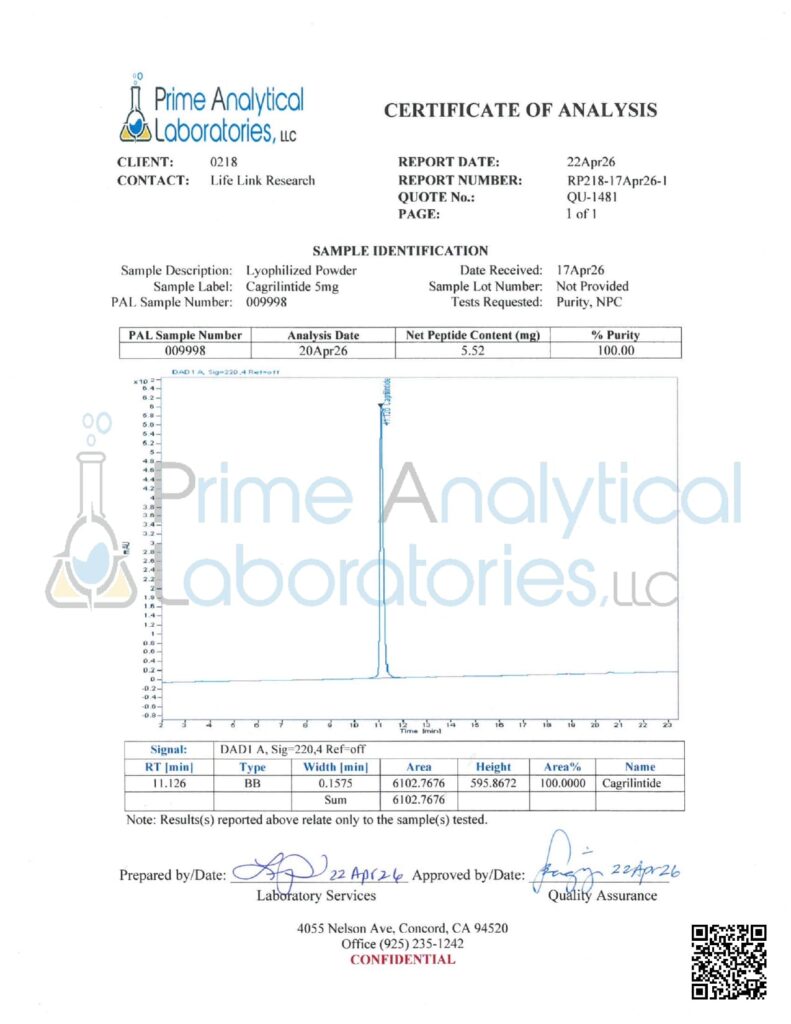
The report should name the laboratory, give a report number and date, and state a lot number you can match to your vial. Our Cagrilintide 5mg batch report from Prime Analytical Laboratories in Concord, California, numbered RP218-17Apr26-1 and analysed on 20 April 2026, is a useful shape to compare against: one named peak at 11.126 minutes, area purity reported at 220 nm, and a net peptide content of 5.52 mg against a 5 mg label. That last line is the one people skip. Net peptide content is what you actually have, after salt and water. Identity and purity run on every Life Link batch, with heavy metals, endotoxin, and sterility on a rotating cycle, all published under third-party testing. Anything that looks off is worth checking against a fuller walkthrough of how to verify a peptide COA.
Regulatory Status
As of 21 November 2026, CagriSema is investigational and not FDA-approved. Novo Nordisk filed a New Drug Application with the US Food and Drug Administration in December 2025 and states a decision is expected in Q4 2026, saying plainly in its 14 November 2026 release that “CagriSema is not approved for use in the United States.”
Material sold under that name for laboratory work is a research reagent. It is research-grade, it has not been evaluated or approved by the FDA, and it is not for human or veterinary use.
Storage of the Lyophilized Blend
Keep the sealed vial at -20°C, protected from light. Both peptides are supplied as a lyophilized powder, and both are soluble in water or DMSO for assay preparation. Let the vial reach room temperature before opening, and keep freeze-thaw cycles to a minimum, since the amylin-type component is the more prone of the two to aggregation.
FAQs
Is CagriSema one peptide or two?
Two. Cagrilintide and Semaglutide are separate molecules supplied in the same vial, with no chemical bond between them. Each keeps its own sequence, molecular weight, and receptor target, which is why a blend certificate of analysis has to report on both of them separately.
What is the molar ratio in a 5/5mg CagriSema vial?
About 1 to 1.07. Five milligrams of Cagrilintide at 4409.0 g/mol works out to roughly 1.13 micromoles, and 5 mg of Semaglutide at 4113.6 g/mol to roughly 1.22 micromoles. Equal milligram amounts give slightly unequal molar amounts.
Why does a CagriSema COA show two HPLC peaks?
Because the two peptides carry different fatty-diacid chains, a C20 on Cagrilintide and a C18 on Semaglutide, with different linkers and attachment points. That difference in hydrophobicity separates them on a reversed-phase column, so each elutes at its own retention time.
What molecular weight should a COA list for Cagrilintide?
4409.0 daltons as the average mass, or 4406.25 monoisotopic. A figure near 3974 points to the backbone without its C20 diacid and gamma-Glu lipidation, which is a different molecule and a reason to query the report before using the vial.
Is CagriSema FDA approved?
No. As of 21 November 2026, it is investigational. Novo Nordisk filed a New Drug Application in December 2025, expects a decision in Q4 2026, and states that CagriSema is not approved for use in the United States. Research-grade material is sold for laboratory use only.
Are Cagrilintide and Semaglutide sold as separate research vials?
Yes. A Cagrilintide 5mg vial and a Semaglutide 5mg vial are both available on their own, each with its own batch certificate, which is the simpler route when an assay only calls for one of the two receptor families.
Get the Blend With Its Batch COA
If your work calls for both receptor families in one preparation, the CagriSema 5/5mg research blend carries 5 mg of Cagrilintide and 5 mg of Semaglutide, with identity by ESI-MS and purity by HPLC on the batch certificate that ships with it. Check both masses and both peaks against the table above when it arrives.
For Research Use Only. Not for use in diagnostic or therapeutic procedures. Full terms are set out in the research disclaimer.
References
- PubChem CID 171397054, Cagrilintide: https://pubchem.ncbi.nlm.nih.gov/compound/171397054
- PubChem CID 56843331, Semaglutide: https://pubchem.ncbi.nlm.nih.gov/compound/56843331
- Cao J et al., Structural and dynamic features of cagrilintide binding to calcitonin and amylin receptors, Nature Communications, 10 April 2025. PMID 40204768: https://www.nature.com/articles/s41467-025-58680-y
- Novo Nordisk, CagriSema REDEFINE 9 trial release, 14 November 2026: https://www.novonordisk-us.com/media/press-releases/cagrisema-redefine-9-trial-obesityweek-2026.html
- Novo Nordisk, R&D pipeline: https://www.novonordisk.com/science-and-technology/r-d-pipeline.html
- Chromatography Forum, Everything Elutes Early in One Peak, 22 May 2013: https://www.chromforum.org/viewtopic.php?t=22699
What Is Lipo-C 216? Composition, Label Math & COA
Pick up a vial of Lipo-C 216 and the label gives you a number instead of an answer. The liquid is deep…
Read article
What Is the KLOW Peptide Blend? Composition, Ratio, COA & US Supply
Quick Answer The KLOW peptide blend is an 80mg research combination of GHK-Cu 50mg, BPC-157 10mg, TB-500 10mg and KPV 10mg, a…
Read article
What Is PT-141 (Bremelanotide)? Structure, Receptors & COA
Quick Answer PT-141 is the research code for bremelanotide, a synthetic cyclic peptide studied at melanocortin receptors. Seven amino acids, one ring,…
Read articleResearch-grade peptides
99%+ purity. Verified every batch.
Identity and purity tested on every batch by third-party labs, Janoshik Analytical and US-based laboratories. Shipped same day from California.
Shop all peptides