Order within –h –m for same-day dispatchFree shipping on orders over $250Free Bacteriostatic Water 30ml with $500+ purchaseEvery batch tested by an independent lab
A certificate of analysis is supposed to be your proof that a research peptide is what the label claims. It only works as proof if the document is real. Grey-market sellers have learned that a slick-looking COA sells product, so a screenshot with a purity number and a lab logo is easy to copy, edit, or reuse across every batch. The good news is that a genuine COA leaves a trail a fake cannot easily follow. Here is how to check it in a few minutes.
What Is a Peptide COA? (Quick Recap)
A peptide certificate of analysis is a batch-specific lab report that states what a vial contains and how pure it is. The two results that carry the load are identity, measured by mass spectrometry, and purity, measured by HPLC. A full COA links both to a specific lot number and test date.
The keyword there is batch-specific. A COA describes one production run, so the numbers on it apply to the vial that came from that run and no other. If you have never worked through one line by line, our guide to reading a peptide COA breaks down each field. This piece picks up where that leaves off: confirming the document is genuine.
Why Fake & Generic COAs Exist
Fake and generic COAs exist for one plain reason: a certificate sells peptides, and producing a real one costs money. Independent testing runs a fee per batch, so a seller cutting corners feels a strong pull toward faking the paperwork over paying for the test.
The forms this takes are predictable. Some sellers run one legitimate test, then paste that single COA onto every product and every future batch, so the document no longer describes what you receive. Others build a COA in an image editor, complete with an invented purity figure and a copied lab logo.
A few post a real lab’s report for a product they do not actually sell. Each shortcut hands you a number with nothing behind it, which is why the checks below focus on tying the document to a real batch and a real lab.
How to Verify a Peptide COA Is Real: Step by Step
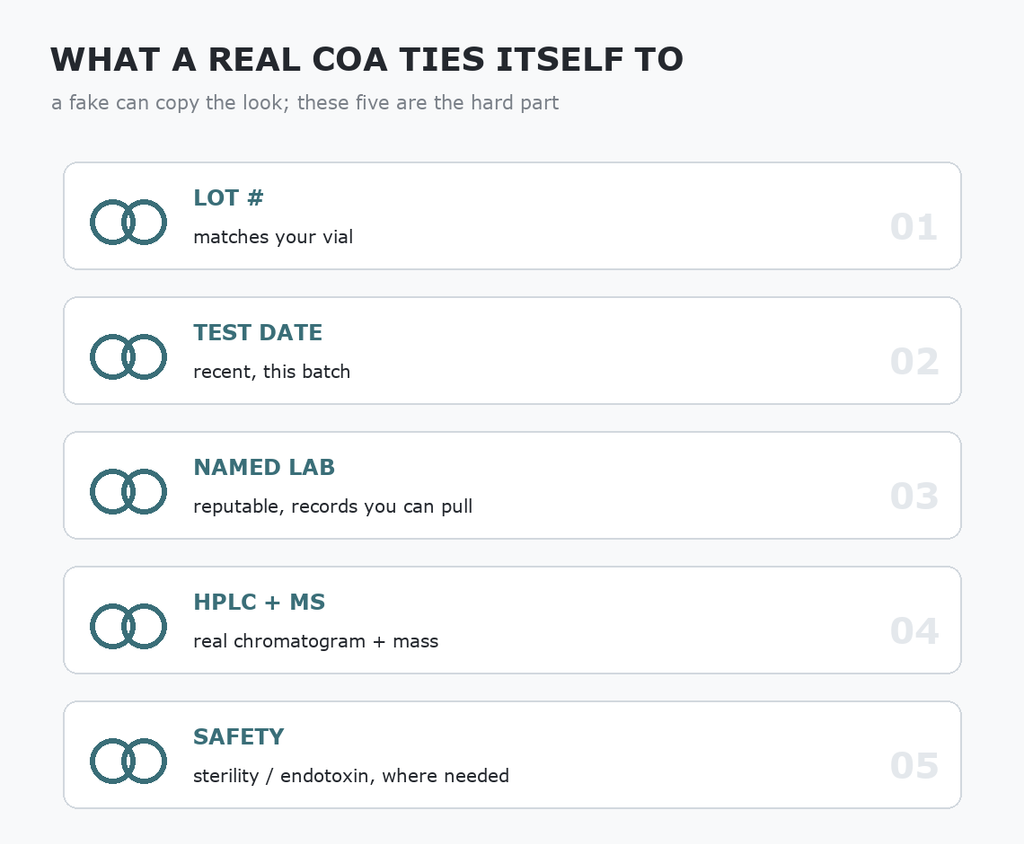
Verifying a COA is a five-step check, and you can run all of it before you buy. Each step ties the document to something a fake cannot easily produce: a matching batch, a recent date, a reputable lab, real instrument data, and safety results where they apply.
Confirm the lot or batch number on the COA is the one shown on your vial or product page.
Check the test date is recent and belongs to that batch.
Verify the testing lab is named, reputable, and ideally accredited, with COAs you can actually access.
Confirm HPLC purity and mass-spec identity are both present, with real data and not just a headline percentage.
Look for sterility and endotoxin results where the research use calls for them.
Clear all five and the certificate is trustworthy. Miss one and you have a question worth asking before any money changes hands. The sections that follow take each step in turn.
The five features of a genuine COA
Step 1: Match the Lot/Batch Number
Start with the lot or batch number, because it is the thread that ties the whole certificate to your vial. A genuine COA carries a lot number, and that number should appear on the product itself or on the page you are buying from. When the two match, the report describes the material in front of you.
A mismatch, or a COA with no lot number at all, is the most common tell of a reused or generic certificate. If a single document shows up under several different products, it is describing none of them accurately. Reputable vendors publish a separate COA per batch and let you match it before ordering, so this check takes seconds.
Step 2: Check the Test Date
Next, read the test date. It should be recent and it should belong to the batch you are looking at, since peptides are tested as they are produced. A date from years ago on a current product suggests the COA was recycled from an older run.
There is a practical reason the date carries weight beyond freshness. Peptides can degrade over long or poor storage, so a purity figure from a test run long before your vial was made no longer describes the material reliably. A current, batch-tied date keeps the number meaningful.
Step 3: Verify the Testing Lab
The signal that carries the most weight is the lab itself. A real COA names the laboratory that ran the analysis, and that lab should have a reputation you can check. An unnamed “independent lab” gives you nothing to verify, while a named facility can be searched, confirmed, and often looked up directly.
Reputation and access go together. A well-regarded third-party peptide lab publishes its results in records you can pull up, so the report stands as an independent entry you can find, beyond whatever PDF the seller emailed. Accreditation raises the bar again: a lab certified to ISO/IEC 17025, the international standard for testing competence, has had its methods and impartiality checked by an outside body.
Labs such as Janoshik Analytical are widely used precisely because their reports are independently searchable. For the difference between an outside lab and a vendor grading its own product, see our guide on third-party vs in-house testing.
Step 4: Confirm HPLC Purity + Mass-Spec Identity
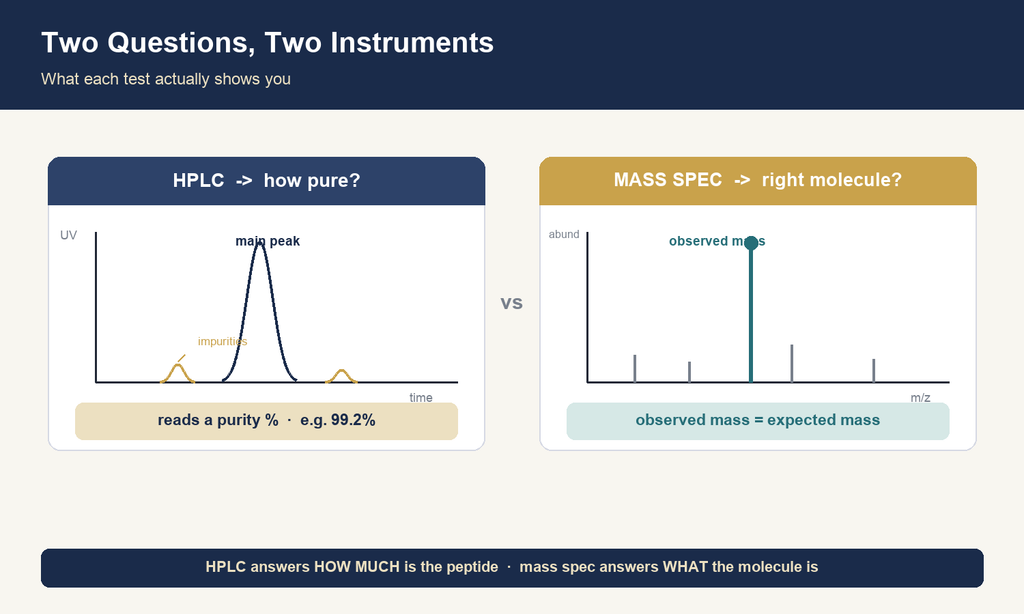
A trustworthy COA answers two questions with two methods, and both should be on the page. HPLC gives the purity percentage, the share of the sample that is your target peptide. Mass spectrometry gives identity, confirming the vial holds the peptide you ordered and not a different sequence.
The identity result is the one a cheap fake tends to fumble. A real LC-MS line shows the observed mass next to the theoretical mass for that peptide, and the two should match within the instrument’s resolution.
Look past the headline number to the actual data: a real report shows the HPLC chromatogram and the mass spectrum, while a fake often shows only a percentage. Our HPLC vs mass spectrometry guide explains what each proves.
Step 5: Look for Sterility/Endotoxin (Where Relevant)
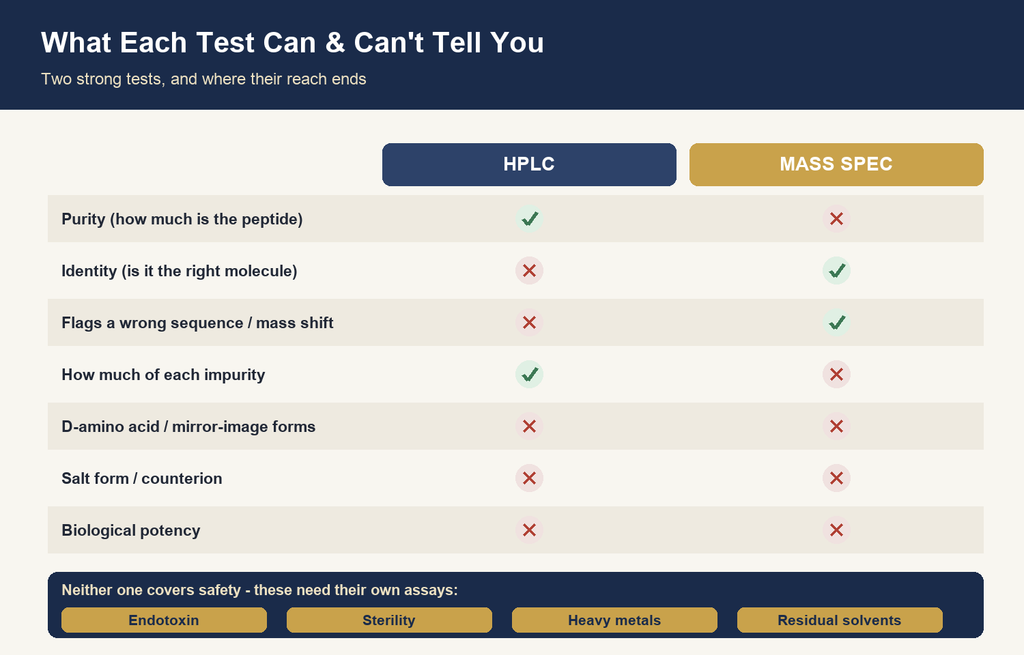
For any peptide headed into cell or animal research, purity and identity are only part of the picture. Sterility and bacterial endotoxin testing catch contamination that a purity percentage never would, and a thorough COA reports them alongside the core results.
These results carry the most weight for sensitive work, where a stray endotoxin could throw off an inflammatory readout. A vendor that runs a broader safety panel and publishes those lines is showing you more of its hand. Their absence is a smaller flag than a missing lot number, though for research that touches living systems it is worth confirming.
Red Flags of a Faked or Generic COA
Some patterns tell you a COA is decorative before you finish reading it. Any single one is a reason to slow down and ask the vendor a direct question.
No lot number or test date. With nothing tying the document to a batch, it describes nothing you can hold.
No named lab. A vague “independent lab” credit leaves you no facility to look up.
One COA for every product. A single certificate reused across the catalog is a template, not a result.
A picture with no readout. A purity badge floating free of a chromatogram or spectrum shows a conclusion and buries the work.
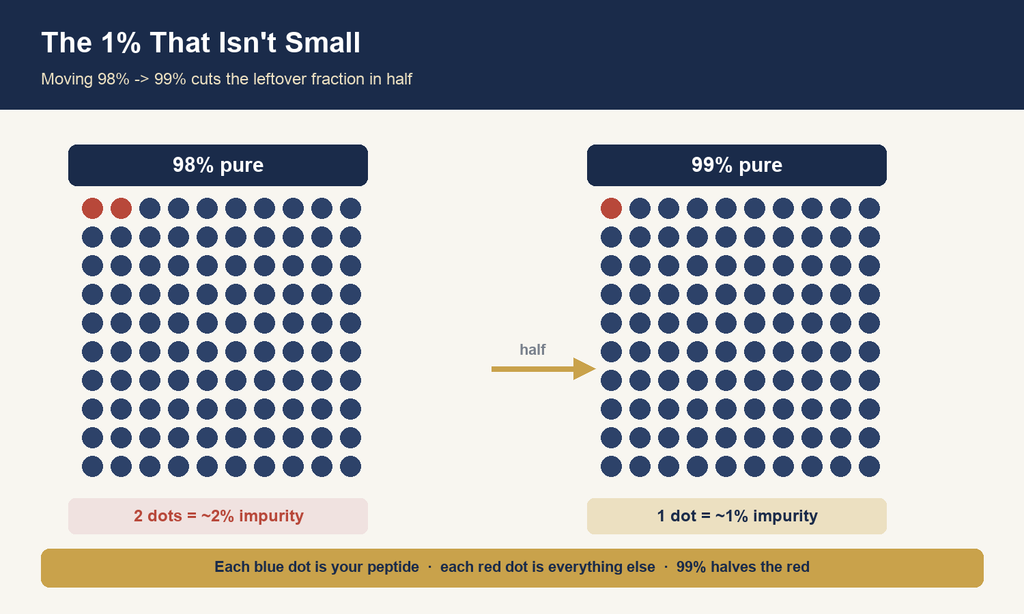
Mismatched or impossible figures. A purity number that clashes with the vial label, or shifts between the page and the PDF, points to editing. Our explainer on 98% vs 99% purity covers what those numbers should and should not do.
Spot two of these on one certificate and the safe move is to buy from a source that documents each batch.
Real COA vs Decorative COA
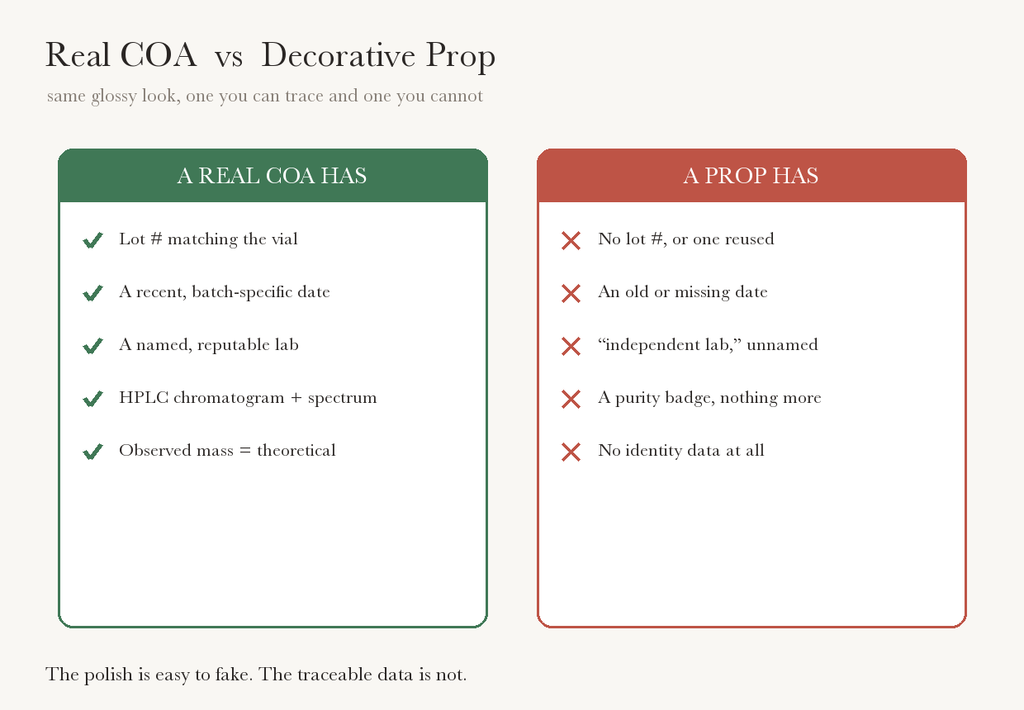
The gap between a real COA and a decorative one comes down to whether the document can be traced. A real certificate is batch-specific, names its lab, and shows the underlying instrument data, so every claim on it can be followed back to a source. A decorative COA is built to reassure at a glance and falls apart the moment you check a detail.
A real COA has
A decorative prop has
A lot number that matches the vial
No lot number, or one reused across products
A recent, batch-specific test date
An old or missing date
A named, reputable lab
“Independent lab” with no name
HPLC chromatogram + mass spectrum
A purity badge and nothing else
Observed mass matching theoretical
No identity data at all
The difference is not how polished the PDF looks. A convincing design is the easy part to fake; the traceable data is the hard part.
A real COA versus a decorative prop
What to Do If a COA Can’t Be Verified
If a certificate fails a check, the safe move is to pause and ask the vendor for the batch-specific COA that matches your lot, from a named lab. A legitimate seller can produce it quickly, since the document already exists for every batch they stock or ship.
A vendor that stalls, sends the same generic file again, or cannot name its lab has told you what you need to know. There is no research upside to a peptide whose identity and purity you cannot confirm, and plenty of downside if the material is off-spec. When verification fails and the seller cannot fix it, walk away and buy from a source that publishes real, batch-matched COAs.
Frequently Asked Questions
Can peptide COAs be faked?
Yes, a COA is a document, so it can be edited, invented, or reused. Common fakes include an image-editor certificate with a made-up purity number, a real lab’s report reused across every batch, and a genuine COA posted for a product the seller does not actually stock. Verifying it against a batch and a named lab is how you catch these.
How do I know a peptide COA is real?
Do these five checks: the lot number matches your vial, the test date is recent and batch-specific, the lab is named and reputable, HPLC purity and mass-spec identity are both shown with real data, and safety testing appears where relevant. A certificate that clears all five is trustworthy.
What should a real peptide COA include?
A real COA includes a lot or batch number, a test date, the named testing laboratory, an HPLC purity result with a chromatogram, and a mass-spectrometry identity result showing observed mass against theoretical mass. For sensitive research it also includes sterility and endotoxin results. Each item ties the document to a real batch and lab.
Should the lot number on the COA match the vial?
Yes, and this is the single most important check. The lot number on the certificate must match the number on your vial or product, because a COA describes one specific batch. A mismatch, or a missing lot number, means the document does not describe the material you are actually receiving.
The Bottom Line
A peptide COA is only proof when the document is real, and confirming that takes about five minutes. Match the lot number to your vial, check that the test date is recent and batch-specific, confirm the lab is named and reputable, and look for both an HPLC purity result and a mass-spec identity result backed by real data, with sterility and endotoxin where the work calls for it.
A certificate that clears those checks, from a lab whose COAs you can access, is worth trusting. One that cannot is a reason to buy elsewhere.
Disclaimer
This article is for educational and informational purposes only. The peptides referenced are research-use-only, not for human or veterinary consumption, and are not FDA-approved. Nothing here is medical or legal advice. Intended for adults 18 and older.
When a vendor says its research peptide is 99% pure, the number is only half the story. The other half is who measured it. A purity figure from an independent lab and the same figure from the seller’s own bench carry very different weight, because one party has money riding on the answer and the other does not. Third-party vs in-house peptide testing comes down to that difference in incentive, and it decides how much a COA is worth.
What Is In-House Peptide Testing?
In-house testing is quality control a vendor runs on its own product, in its own lab or on its own equipment. Done well, it is genuinely useful: fast feedback during production, tight control over the process, and a first look at whether a batch is on spec before it ships.
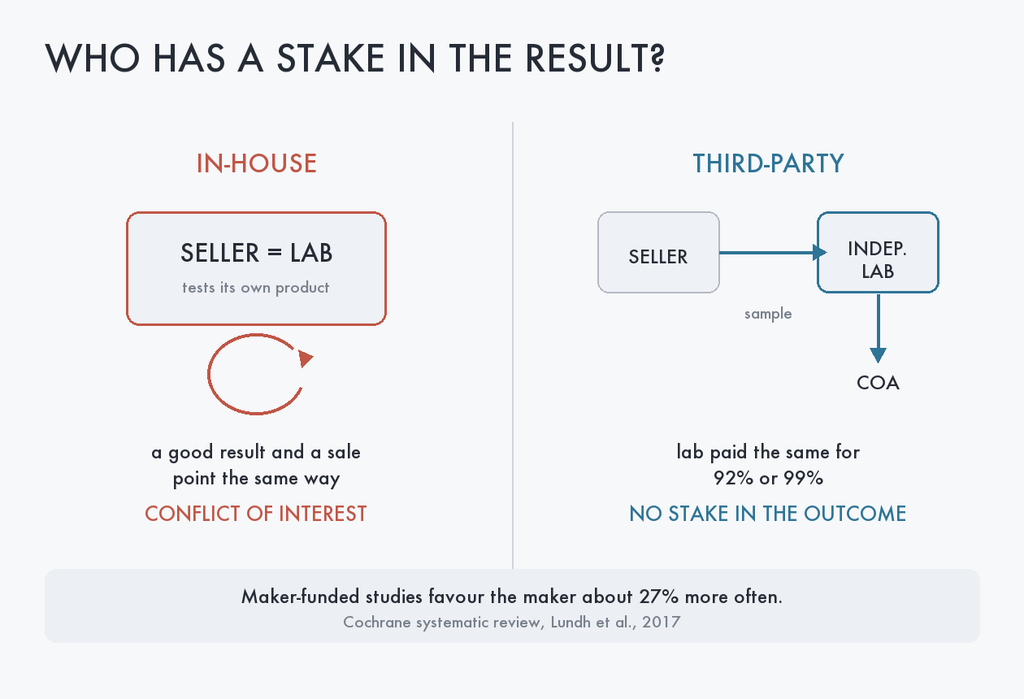
The catch is structural. The company checking the product is the same company selling it, so a passing result and a profit both point the same way. That is a textbook conflict of interest, and it does not require anyone to act in bad faith to skew things. A generous integration here, a borderline batch waved through there, and the reported number drifts upward.
Picture a 96% batch where a small shoulder peak gets read as part of the main peak; suddenly the label says 98%, and no one lied outright. In-house data answers a real question, and it answers it from an interested party.
What Is Third-Party Peptide Testing?
Third-party testing sends a sample to an independent analytical lab that has no stake in whether the peptide passes. The lab gets paid the same to report 92% or 99%, which removes the incentive to inflate a result.
That independence is the entire point. An outside lab runs the same core methods, HPLC for purity and mass spectrometry for identity, but reports them without a commercial reason to round up. When the lab is also accredited, its competence has been checked by an external body too. The result is a number a buyer can weigh at face value, tied to a specific batch and traceable back to a named facility.
Third-Party vs In-House: Key Differences
Both approaches use similar instruments. What makes them distinct is objectivity, accountability, and how far you can verify the claim. This table lays out where each stands.
Feature
In-house testing
Third-party testing
Objectivity
Seller grades its own product
Independent lab, no stake in the result
Accreditation
Rarely external
Often ISO/IEC 17025 accredited
Verifiability
Hard to confirm
Traceable to a named lab and batch
Cost to vendor
Low
Higher (paid per batch)
Trust signal
A starting point
The recognized standard
The pattern is consistent. In-house testing is cheaper and faster for the vendor, and it asks you to take the seller’s word. Third-party testing costs more and gives you a result you can actually check. For anything going into research, the checkable number is the one worth paying for.
Why Third-Party Testing Wins on Objectivity
Independent verification is the trust standard because self-interested measurement tends to run optimistic, and there is hard evidence for that pattern. A Cochrane systematic review by Lundh and colleagues found that studies funded by a product’s manufacturer reported favorable results markedly more often than independent studies, with a risk ratio of 1.27 for efficacy outcomes and 1.34 for overall conclusions.
That research covers drug and device trials, though the mechanism carries straight over to peptide COAs. When the party reporting the number benefits from a good number, the framing, the method choices, and the borderline calls all lean gently in one direction. No fraud is needed for the effect to show up.
In-house VS third-party peptide testing
This is why “we test our own product” falls short as a trust claim. It can be true and still be optimistic. An independent result removes the incentive entirely, which is the whole reason buyers and regulators treat outside verification as the higher bar. The point is not effort; a vendor can test carefully and still be the wrong party to certify the outcome.
What Proper Testing Should Include
A trustworthy peptide test answers two separate questions and checks for contamination.
Purity asks how much of the sample is the target peptide, measured by reversed-phase HPLC.
Identity asks whether the sample is the right peptide at all, confirmed by mass spectrometry against the molecule’s known mass. A high purity number on the wrong compound is worthless, so both belong on the report.
Contamination screening is the third leg, and it carries the most weight for anything used in cell or animal research.
Bacterial endotoxin and sterility checks catch the problems that a purity percentage never would.
Endotoxin is the one that bites quietly in the lab: a peptide can be 99% pure and still carry enough bacterial residue to skew an inflammatory readout, which is why the check belongs on the COA for anything touching cells.
The FDA treats HPLC as the validated purity method for synthetic peptides and flags impurities down to 0.10% of the active ingredient, which sets a useful bar for what a serious COA should resolve. We run all of this as a multi-test panel, described in detail on our testing page, with identity by LC-MS and purity by RP-HPLC on every batch.
Can You Trust In-House-Only Testing?
In-house-only testing is a caution flag, though it is a soft one. A vendor with a real internal lab and consistent process control can produce accurate numbers, and in-house QC is a legitimate first line of defense. The problem is verification, since you have no independent point of comparison.
The stronger setup pairs the two: in-house checks during production for speed, plus third-party confirmation on the batch that ships. That combination gives a vendor fast feedback and gives you an outside number to trust. When a seller offers in-house data alone, treat it as unconfirmed until an independent COA backs it up. It might be perfectly accurate; you simply cannot tell from the inside.
Named Labs & Accreditation (ISO 17025)
“Independent lab” means little when the lab goes unnamed. The signal that carries weight is a named facility accredited to ISO/IEC 17025, the international standard for testing competence. The standard exists precisely to remove doubt: it requires laboratories to work “without bias” and to manage conflicts of interest, per the ISO/IEC 17025:2017 requirements.
Accreditation also proves skill. Labs earn it through proficiency testing, where they analyze blind samples and their results are compared against other labs, an objective measure of competence that self-declared quality can never supply. And accreditation is granted by recognized bodies such as ANAB in the US, so it cannot be self-declared. A vendor that names its lab, Janoshik Analytical in our case, lets you trace the claim, and a vendor that hides behind ‘independent testing’ badge gives you nothing to check.
Red Flags in Peptide Testing Claims
A few patterns should slow you down before you buy. Each one quietly shifts the burden of proof onto you, the buyer, and none of them survives a direct question to the vendor.
No named lab. “Third-party tested” with no facility named cannot be verified, so it functions as decoration.
No accessible COA. A testing claim with no batch document behind it is a claim with nothing to inspect.
“Tested” with no data. A pass/fail badge and no chromatogram or mass spectrum hides more than it shows.
In-house-only. Internal numbers with no outside confirmation lean optimistic by default.
Generic or mismatched COAs. A single “sample” certificate reused across lots tells you nothing about the vial you receive.
Any one of these on its own warrants a question. Two or more together is a reason to source elsewhere.
How to Check a Vendor’s Testing
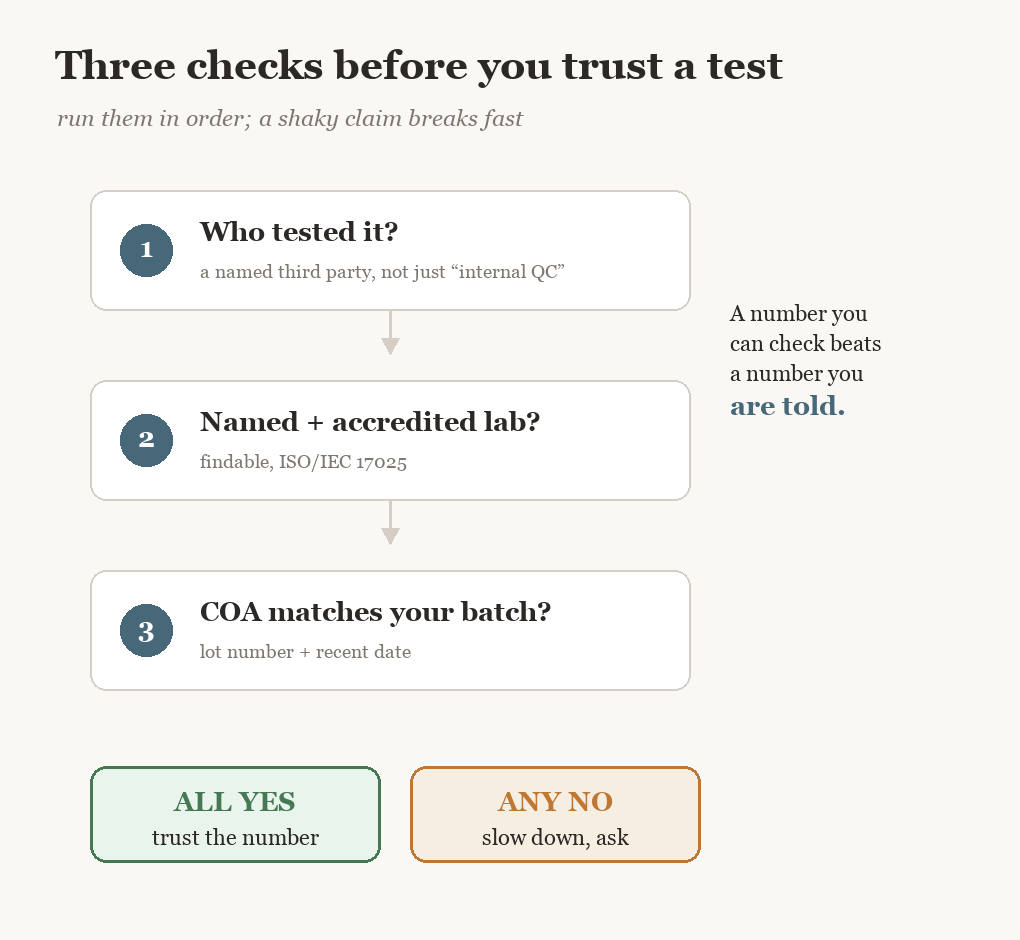
Verifying a vendor takes about two minutes and three questions. Run them in order, and a shaky testing claim falls apart quickly.
Three checks for peptide testing
Who tested it? Find the COA and read the lab name. A named, accredited third party is the answer you want; “internal QC” alone is a maybe.
Is the lab real and accredited? Search the facility. An ISO/IEC 17025 lab with a findable footprint beats an unnamed “partner lab” every time.
Does the COA match your batch? Confirm the lot number on the certificate matches the vial, with a recent test date. A generic sample COA does not count. You can learn how to read a peptide COA if you need specific guidance.
Reputable vendors make this easy. We publish each batch COA with the full mass spectrum and the HPLC chromatogram, so all three checks can be done before ordering. If a vendor stumbles on any of the three, that hesitation is itself the data point you needed.
Frequently Asked Questions
Is third-party testing better than in-house?
For trust, yes. Both can use the same HPLC and mass-spec methods, but a third-party lab has no financial stake in the result, so its numbers are harder to skew. In-house testing is a useful internal check that carries more weight once an independent COA confirms it.
What labs test research peptides?
Independent analytical labs handle it, and the strong signal is a named facility accredited to ISO/IEC 17025. Janoshik Analytical is one widely used third-party peptide lab. What counts is whether the vendor discloses the lab name and publishes the batch COA that lab produced.
Does in-house testing mean the peptide is fake?
No. In-house testing can be accurate, and many careful vendors run internal QC. It simply cannot be verified from the outside, so treat in-house-only numbers as unconfirmed until an independent COA backs them. The fix is an independent third-party COA that backs the internal result on the batch you receive.
How do I verify a vendor’s testing?
Find the certificate of analysis, read the lab name, confirm the lab is real and ideally ISO/IEC 17025 accredited, then check that the lot number on the COA matches your vial with a recent date. If a vendor cannot produce a lot-matched, named-lab COA, source elsewhere.
The Bottom Line
Third-party and in-house testing can run the same instruments, so the difference is not the method; it is who stands to gain from the result. Independent labs have no incentive to round up, accreditation to ISO/IEC 17025 holds them to impartial, competent work, and the evidence on self-interested reporting shows why that independence carries weight. In-house QC has a place as a first check. Before you trust any research peptide, find the COA, confirm a named accredited lab, and match it to your batch.
Disclaimer
This article is for educational and informational purposes only. The peptides referenced are research-use-only, not for human or veterinary consumption, and are not FDA-approved. Nothing here is medical or legal advice. Intended for adults 18 and older.
To read a peptide Certificate of Analysis (COA), find the batch or lot number on the document, confirm who ran the testing, check the HPLC purity result, verify identity with mass-spectrometry data, review any extra tests, and confirm the dates. A COA documents the quality of one specific batch.
How to Read a Peptide Certificate of Analysis?
If you buy research peptides in the US, the COA is the single most useful piece of paper you should know about. It is where a supplier shows their work: what the compound is, how pure it is, and who checked. Read it well and you protect your experiments, your budget and your reputation. Skim it and you are trusting a random number on a website.
This guide is written for US labs and qualified professionals working with research-use-only (RUO) peptides. We walk through every part of a COA, from the batch number to the mass-spec trace, and we point out the red flags worth catching before material ever reaches your bench. This information is for research and quality control only. It is not medical or clinical advice.
What Is a Certificate of Analysis (COA) for Research Peptides?
A Certificate of Analysis is a lab document that reports the analytical testing for one specific peptide batch. It records the compound’s identity, its purity, and any other quality checks that were run, and it ties all of that to a single lot number so the paperwork points to the exact material you received.
COA Meaning in Peptide Research
Think of a COA as a batch’s report card. It states the peptide name and sequence, the tests performed, the results, and the date, all for one production run. The key word here is batch. A COA is only meaningful when it belongs to the specific lot in your hand, because purity and identity can vary from one synthesis to the next. A general product COA that covers a product line, with your exact batch missing, is a much weaker signal.
What a COA Can and Cannot Confirm
A good COA can confirm plenty: the analytical purity of the tested batch, the identity of the compound by mass, the extra quality checks that were run, and the source of the testing. It gives you documented evidence you can file, cite and audit.
It also has limits worth knowing. A COA reflects the batch at the time of testing. It cannot confirm how the material was stored after it left the lab, whether the label stayed attached to the right vial, or whether the compound is approved for any use in people. Documentation proves quality; it does not grant approval.
COA vs Marketing
Real COAs and marketing brochures can look similar at a glance, so it helps to know the difference. A real COA is batch-specific, names the methods used, and usually includes the underlying data, such as an HPLC chromatogram or a mass-spec trace. A marketing sheet tends to carry a big purity claim, no batch number, no method detail, and no raw data. When a “COA” has no lot number and no chromatogram, treat it as a brochure.
Research Peptides and RUO Labeling in the US
Research peptides are synthetic peptides sold for laboratory experiments, such as in-vitro, ex-vivo and animal-model work. In the US they are labeled Research Use Only (RUO), which means they are supplied for research and carry no therapeutic claims and no clinical approval.
What “Research Use Only” Means for US Labs
RUO is a specific label with a specific job. Under FDA rules for in-vitro diagnostic products (21 CFR 809.10), material in the research phase must carry the statement “For Research Use Only. Not for use in diagnostic procedures.” That wording exists to keep research material out of clinical diagnosis and patient care. For a peptide buyer, the takeaway is simple: RUO compounds belong in controlled laboratory research.
RUO vs Therapeutic Peptides: The FDA Context
The gap between an RUO peptide and a therapeutic one is wide. An RUO peptide is sold under a research framing, with no clinical approval behind it. A therapeutic peptide is a regulated drug, subject to FDA oversight, manufacturing standards and labeling requirements. A COA does not close that gap. It documents that a batch was tested and how pure it was, and that is all it does. Even a compound with strong regulatory momentum stays research-only until it is actually approved, a point we cover in our KPV research guide and its 2026 update.
Why Is “Not for Human Use” Important
Taking the RUO label seriously protects you on several fronts. There is legal liability if research material is used outside its intended context. There are institutional policies and ethics rules that govern how RUO compounds are handled. And there is the simple matter of doing science properly, with material used only for the research it was sold for. Reading a COA carefully and handling RUO material correctly are two halves of the same responsibility.
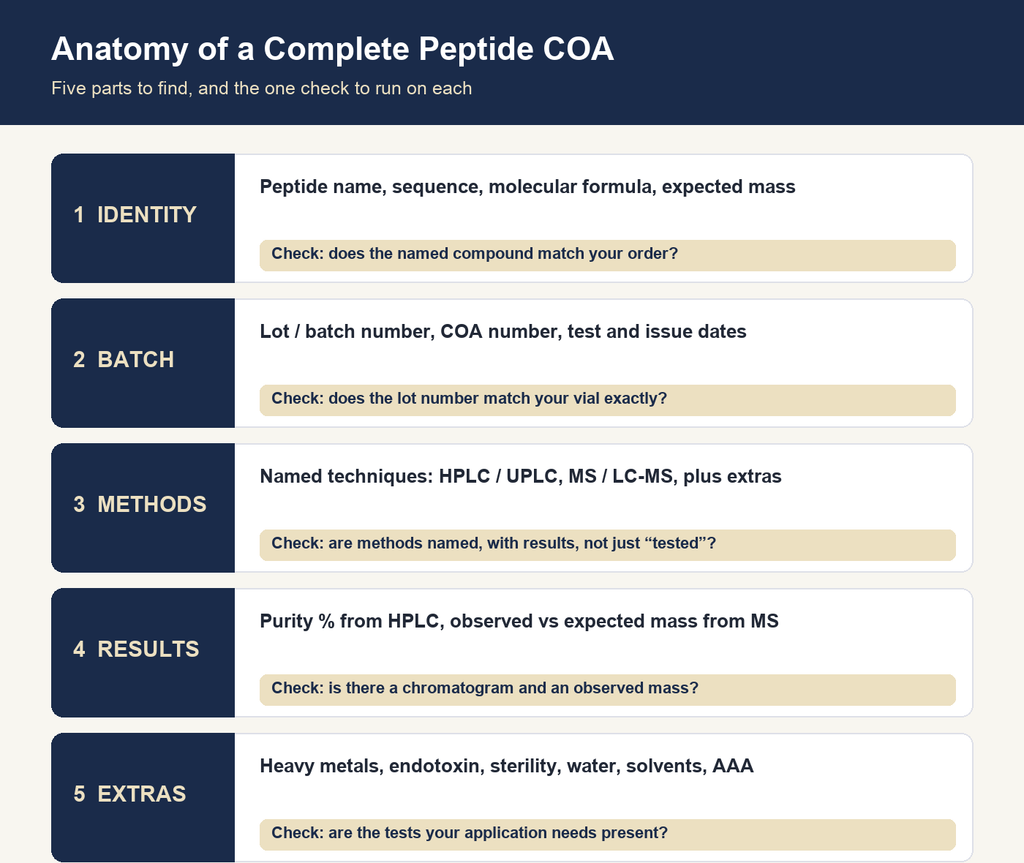
What a Complete Peptide COA Should Include
A complete peptide COA should let you identify the compound, tie it to a specific batch, understand the methods used, and read the results in context. If any of those four things is missing, the document is incomplete.
Product Name, Sequence, Molecular Formula and Expected Mass
The top of the COA should name the peptide clearly and, ideally, give its amino-acid sequence or molecular formula along with the expected (theoretical) mass. These details are important because they let you cross-check identity later. When you reach the mass-spec section, you will compare the expected mass shown here against the observed mass the instrument measured.
Batch or Lot Number, COA Number and Dates
The batch or lot number is the thread that ties this document to your vial. Alongside it you should see a COA or report number for document control, plus a testing date and an issue date. These fields turn a general certificate into evidence for one exact run of material, and they let you check the document is current.
Testing Laboratory and Accreditation
A credible COA identifies who did the testing. Look for a named lab with contact details, and where possible a quality system or accreditation such as ISO/IEC 17025. That standard is the international benchmark for lab competence: it lets a lab “demonstrate that they are technically competent and capable of producing valid and reliable results,” according to ISO. A named, accredited third-party lab is one of the strongest quality signals a COA can carry. We verify every batch through Janoshik Analytical and third-party labs both for exactly this reason.
Analytical Methods and Results
Finally, the COA should name its methods and show their results. Purity usually comes from HPLC or UPLC. Identity comes from mass spectrometry or LC-MS. Extra checks might include heavy metals, endotoxin, sterility and water content. Each method should carry a named technique and a real result, in a format like “Purity (HPLC): 99.1%,” not a vague “tested and passed.”
How to Read a Peptide COA: Step by Step
Reading a COA follows a repeatable order. Match the batch, confirm the testing source, read the purity, verify the identity, review the extra tests, and check the dates. Work through the same six steps for every new lot and nothing important slips past you.
Step 1: Find the Batch or Lot Number
Start with the number. Find the lot number on the COA and check it against the supplier’s published batch records or your order paperwork. Then trace it through your packing slip and inventory record so the whole chain agrees. A COA that does not carry your exact lot number is not documentation for your material, however impressive the results look.
Step 2: Confirm Who Did the Testing
Next, find out who ran the tests. In-house quality control has value, but independent third-party testing carries more weight because it removes the supplier from marking their own homework. Most suppliers stop at one or two tests. We run a third-party testing panel on every batch and verify it through outside labs, so the results you read were not generated in the same room they were sold from. If a COA is vague about the testing source, ask.
Step 3: Read the HPLC Purity Result and Chromatogram
Now read the purity. The HPLC result is a percentage that represents the share of the sample made up of the main peptide. A quick look at the chromatogram tells you more: one tall main peak is what you want, and extra peaks are impurities. As a rough guide, 95% suits early screening, while 98 to 99% is the range most labs want for quantitative or publication-grade work.
Step 4: Confirm Identity with Mass Spectrometry
Purity tells you how clean the sample is. It does not tell you the sample is the right compound. That job belongs to mass spectrometry, which measures the molecular mass and lets you compare it to the expected value. A purity figure without identity data is only half a quality check, so never skip this step.
Step 5: Review the Extra Tests
Depending on your work, the extra tests can matter as much as purity. Water content affects how accurately you convert milligrams to moles. Endotoxin and sterility become important for cell-culture and animal work. Scan these results and decide which ones your specific application needs.
Step 6: Check Dates, Version and Authenticity
Finish on the housekeeping. Confirm the testing date is recent, since a very old COA may not reflect the current batch. Check for a version number or document code so you know you have the latest file. And where a supplier offers a QR code or an online lookup, use it to confirm the document is genuine.
Understanding HPLC Purity on a Peptide COA
HPLC purity is the headline number on most peptide COAs. It reports how much of the tested sample is the target peptide, measured by separating the sample’s components and comparing their sizes. Read it alongside the method and the chromatogram, and it becomes a figure you can trust.
What HPLC Purity Measures
High-performance liquid chromatography pushes a sample through a column so its components separate out and pass a detector at different times. Peptides usually run on reverse-phase HPLC. The output is a chromatogram, a chart of peaks, where the main peptide forms the largest peak and any impurities show up as smaller ones.
How the Purity Percentage Is Calculated
The purity figure comes from peak area. The instrument measures the area under each peak, then reports the main peak’s area as a percentage of the total. A result of 99% means the main peptide accounts for 99% of the detected material, with the remaining 1% spread across minor peaks. It is a relative measure, which is why the chromatogram behind it matters.
Purity Thresholds for US Labs: 95%, 98% and 99%
Different work calls for different thresholds. For early screening or exploratory studies, 95% is often workable. For quantitative studies and publication-grade research, most labs want 98 to 99% or higher. Higher purity means fewer stray variables in your data. The number is only as good as the verification behind it, which is the whole point of our guide on what 98% vs 99% purity actually means: a verified 98% beats an unverified 99% every time.
Reading the Chromatogram and Spotting Impurity Peaks
You do not need to be an analyst to read a chromatogram at a glance. Find the tall main peak, then look for extra peaks along the baseline. A few tiny peaks are normal. Large secondary peaks, a noisy wandering baseline, or impurity peaks the report never mentions are all worth questioning. Retention time (where the main peak sits) should also be consistent with the compound.
How Mass Spectrometry Confirms Peptide Identity
Mass spectrometry confirms that your peptide is actually the peptide on the label. It measures the compound’s molecular mass, which you compare against the expected mass from the sequence. Purity and identity answer different questions, and a complete COA answers both.
Why Identity Matters as Much as Purity
A sample can be 99% pure and still be the wrong compound, or the right compound with the wrong modification. Purity cannot catch that; only identity can. Mass spectrometry rules out mislabeled or mis-synthesized material by checking the mass fits the target. This is why the two methods work as a pair, a relationship we break down in our guide on HPLC vs mass spectrometry testing.
Expected Mass vs Observed Mass
The COA shows two mass figures. The expected (theoretical) mass is calculated from the peptide’s sequence. The observed mass is what the instrument actually measured. When the two line up, the report is showing a real measurement that matches the target compound. A COA that lists only the expected mass, with no observed value, has skipped the measurement that matters.
Acceptable Mass Variance
Observed and expected mass rarely match to the last decimal, and that is fine. Instruments have a tolerance, often within a few Daltons for standard equipment, or tighter in parts-per-million on high-resolution systems. A small, expected deviation is normal. A large gap between observed and expected mass is a reason to pause.
What Mass Spectrometry Does Not Confirm Alone
Mass spectrometry is powerful, and it has limits. It confirms the mass, which strongly supports identity, but a basic mass measurement does not always prove the full sequence on its own. That is why identity and purity are read together, mass spec alongside HPLC, so the batch is checked from two angles at once.
The Extra Tests That Separate a Good COA from a Great One
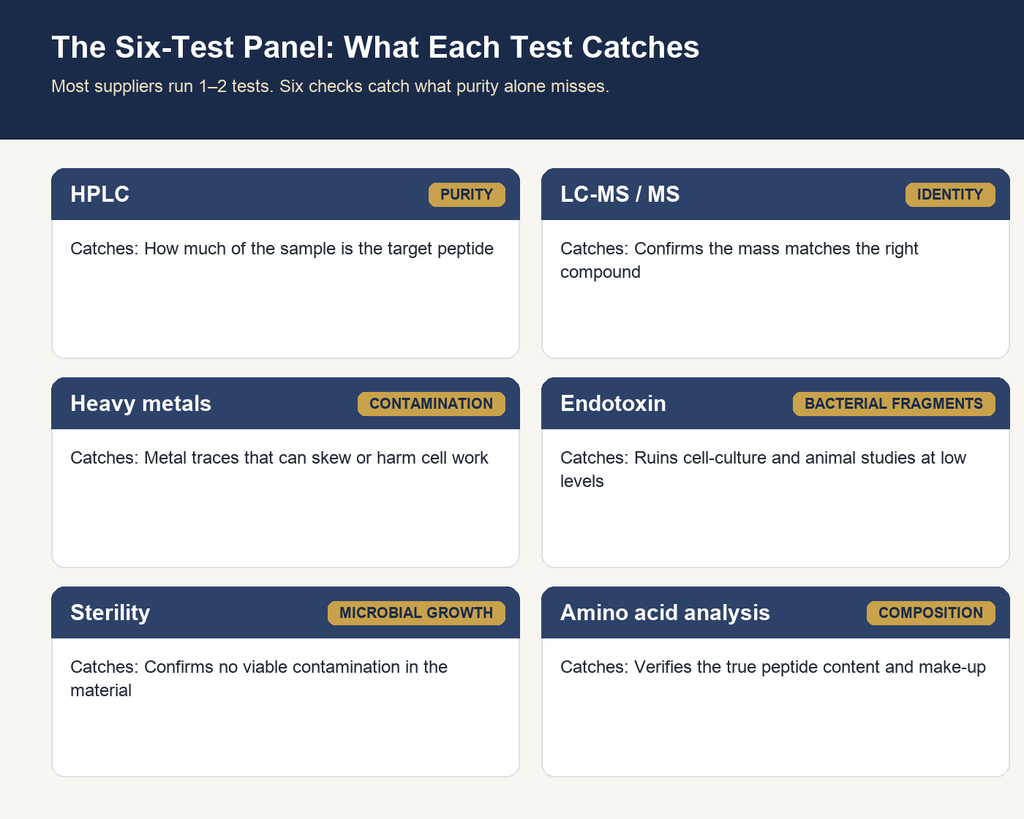
Purity and identity are the baseline. The tests that mark out a serious supplier are the extra ones: heavy metals, endotoxin, sterility and amino acid analysis. Most suppliers run one or two tests. We test identity and purity on every batch, with heavy metals, endotoxin, and sterility on a rotating cycle — the extra checks catch problems purity alone never sees.
Heavy Metals Screening
Heavy-metal contamination can enter during synthesis or handling, and it can quietly skew sensitive assays or harm cell cultures. A heavy-metals screen checks the batch against acceptable limits. For regulatory-sensitive or cell-based work, it is a check worth seeing on the page, so you can confirm it yourself.
Endotoxin and Sterility Testing
Endotoxins are bacterial fragments that can wreck cell-culture and animal studies even at low levels, so endotoxin testing measures them against a threshold. Sterility testing confirms the material is free of viable microbial growth. Both matter most for in-vivo and cell work, where contamination turns a clean experiment into noise.
Water Content
Water content affects your maths. A peptide that has absorbed moisture weighs more than the peptide alone, which throws off any milligram-to-mole conversion. Seeing water content on a COA means fewer surprises in your calculations.
Amino Acid Analysis
Amino acid analysis confirms the peptide’s composition by breaking it down and measuring the amino acids present. It adds another layer of identity confidence on top of mass spec, and it helps verify the true peptide content of the sample. It is one of the checks in our third-party testing panel, and it is rare to see on a standard COA.
When US Labs Should Insist on These
Not every study needs every test, so match the checks to the work.
Cell culture and in-vivo studies lean on endotoxin and sterility.
Quantitative work leans on water content.
Regulatory-sensitive research may need heavy metals and full identity confirmation.
When your experiment is sensitive, ask for the data before you buy, while it can still shape your decision.
How to Verify Overall Peptide Quality from a COA
Verifying quality means reading the whole COA as one picture: identity confirmed, purity above your threshold, the right extra tests present, and recent, traceable testing behind it all. Any single number in isolation can mislead.
Purity vs Identity: Why You Need Both
The core rule is that purity and identity are not the same thing, and you need both. Purity tells you how clean the sample is. Identity tells you it is the right compound. A batch that is pure but unidentified, or identified but impure, fails the test. Trust comes from the two together.
Setting Your Lab’s Quality Thresholds
Decide your standards before you shop. Set a minimum purity for your work, make mass-spec identity a non-negotiable, and list the extra tests your applications require. Written thresholds turn “this looks fine” into a clear pass-or-fail, and they keep decisions consistent across your team.
A Simple New-Batch Quality Checklist
Turn the six reading steps into a checklist for every new lot: batch matched, testing source confirmed, HPLC purity above threshold, mass-spec identity confirmed, extra tests reviewed, dates current. Six ticks and the batch is cleared for use. A missing tick is a question to resolve first.
When to Reject a Batch
Some findings are a clear stop. Reject or quarantine a batch when the purity sits below your threshold, when there is no mass-spec identity data, when the observed and expected mass disagree sharply, or when the COA cannot be tied to your vial. Rejecting a doubtful batch costs far less than a ruined experiment.
Common COA Red Flags US Buyers Should Watch For
Most weak COAs share the same handful of tells. Once you know them, you can spot a thin document in seconds, before it becomes a problem in your data.
Missing or non-specific batch numbers. A COA with no lot number cannot be tied to your material. A generic “product” COA is not enough.
A purity number with no chromatogram. A percentage with no underlying HPLC trace is a claim you cannot check.
No mass-spec identity data. Purity alone leaves identity unconfirmed, so a COA with no observed mass is half a document.
A vague or untraceable testing lab. “Independent lab” with no name, address or accreditation is not verifiable.
Outdated testing dates. A very old COA may not reflect the batch you actually received.
A COA that does not match the product page. Different sequence, purity or details between the listing and the COA is a real inconsistency to resolve.
COA Best Practices for US Labs
A COA is only useful if you can find it again. Storing, linking and reviewing COAs the same way every time turns a pile of PDFs into an audit trail you can defend.
Documenting COAs in Your Lab
Keep every COA in one place, whether that is a LIMS, a shared drive or a dedicated QA folder. Use a consistent naming convention, such as compound plus batch plus date, so any file is one search away. A tidy repository saves hours during an audit or a publication review.
Linking COAs to Inventory, Experiments and Publications
Tie each COA to the material it documents. Tag it in your inventory against the lot, reference it in your experiment notes, and cite the batch in the methods section of any resulting paper. That chain lets anyone retrace exactly which material produced which result.
A COA-Review SOP and Training Staff
Write a short standard operating procedure for COA review, covering the six steps and who signs off. Then train new staff against it with an onboarding checklist. When everyone reads a COA the same way, quality stops depending on who happened to open the box.
Choosing a Trusted US Research Peptide Supplier
A trustworthy US supplier makes quality easy to verify. Look for transparent, batch-specific COAs, named third-party testing, a broad and consistent test panel, and quick access to the documentation behind every order.
Quality Signals to Look For
The strongest signals are practical ones. A public, searchable COA library. Third-party testing through a named lab. A test panel that goes beyond the basic one or two checks. We built around these on purpose: a third-party testing panel on every batch, third-party verification through Janoshik and third-party labs, and 99%+ purity as the everyday standard on every batch.
Questions to Ask a Supplier About Testing
A few direct questions reveal a lot.
Is testing done in-house or by a third-party lab?
Can you share the chromatogram and mass-spec data for this specific batch?
What does your test panel include?
A confident supplier answers quickly and shows the documents, but a vague answer is its own signal.
Example: Verifying a New Peptide Batch (Walk-Through)
Here is the whole process in one short workflow you can run on any new lot, whether it is BPC-157, MOTS-c, a GLP research compound or PT-141.
1. Download the COA for the batch from the supplier’s library.
2. Match the batch number on the COA to your vial and packing slip.
3. Confirm the testing lab and check for third-party verification.
4. Read the HPLC purity and glance at the chromatogram for stray peaks.
5. Verify the mass-spec identity by comparing observed and expected mass.
6. Review the extra tests your application needs, such as endotoxin or water content.
7. Confirm the dates are recent and the document version is current.
8. Archive the COA in your LIMS or shared drive against the lot.
Frequently Asked Questions
What Purity Percentage Should US Labs Look For in Research Peptides?
It depends on the work. Around 95% suits early screening, while 98 to 99% or higher is the common target for quantitative and publication-grade studies. Just as important, the purity should be verified, since a documented 98% is worth more than an unverified 99%.
Do All COAs Need Both HPLC and Mass-Spec Data?
As best practice, yes. HPLC reports purity and mass spectrometry confirms identity, and the two answer different questions. If a COA shows purity but no observed mass, the compound’s identity is not fully confirmed, so treat that as an incomplete document.
How Often Should COAs Be Updated for Recurring Batches?
Each new batch or lot should get its own COA, because purity and identity can shift between production runs. A COA from a previous lot does not cover the vial in your hand, however recent it looks.
Can a US Lab Rely on Supplier-Run Tests, or Should It Insist on Third-Party Results?
In-house testing can be acceptable, and third-party data is stronger because it is independent. If a COA is unclear about who ran the tests, ask. We verify every batch through Janoshik Analytical and domestic third-party labs so the results stand on their own.
What Should a Lab Do if the COA Does Not Match the Order Records?
Quarantine the batch, hold it out of any experiment, and contact the supplier to resolve the discrepancy before use. A mismatch between the label and the COA breaks the chain of traceability, and using the material anyway risks your data.
What Extra Tests Matter Beyond Purity and Identity?
Heavy metals, endotoxin, sterility, water content and amino acid analysis all add quality confidence. Which ones matter depends on your application, with endotoxin and sterility mattering most for cell-culture and animal work.
Conclusion: Using COAs to Protect Your Research and Your Lab
Reading a peptide COA well comes down to three pillars. The document must be batch-specific, tied to the exact lot in your hand. It should carry both HPLC purity and mass-spec identity, so the material is checked from two angles. And it should rest on legitimate, recent, ideally third-party testing you can trace.
Get those three right and a COA does real work for you. It supports reproducible science, it stands up to audits and publication review, and it gives you confidence in every result that follows. Build your own COA checklist, set your quality thresholds, and lean on suppliers who make their documentation easy to check. Check out our research compounds and their batch COAs and put the checklist to work on your next order.
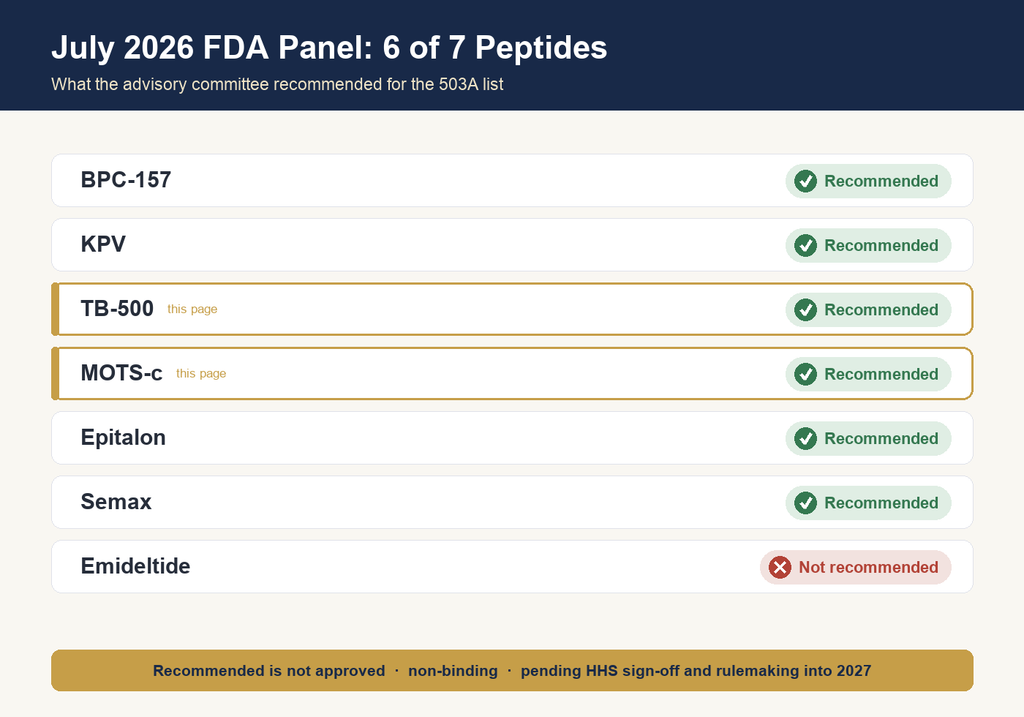
Quick answer: In July 2026, an FDA advisory committee voted to recommend both TB-500 and MOTS-c for the Section 503A compounding list, part of a wider vote that backed six of seven peptides reviewed. A recommendation is not approval, though. Both peptides stay research-use-only while the FDA works through final rulemaking, a process expected to run into 2027.
TB-500 & MOTS-c
The July 2026 advisory meeting was the biggest regulatory moment the peptide industry has seen in years, and the headlines that followed were easy to misread. TB-500 and MOTS-c both came out of it with a favorable committee vote, yet neither is FDA-approved, and nothing about their legal status changed overnight. This guide lays out exactly what the panel decided, what each peptide is studied for, and what still has to happen before anything shifts.
Research use only. The material below summarizes a regulatory event and preclinical (laboratory and animal-model) findings. It is not medical guidance, and neither peptide is approved for human or veterinary use.
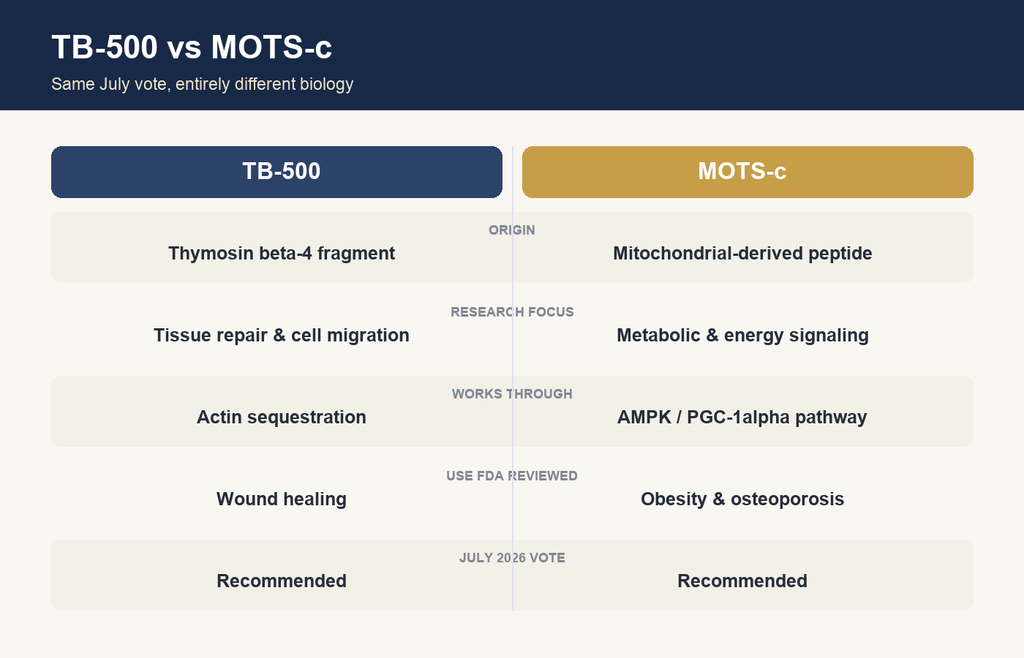
Status at a glance
TB-500
MOTS-c
Peptide class
Thymosin beta-4 fragment
Mitochondrial-derived peptide
Research focus
Tissue repair, cell migration
Metabolic and mitochondrial signaling
July 2026 committee vote
Recommended for 503A list
Recommended for 503A list
FDA-approved?
No
No
Current status
Research-use-only, pending rulemaking
Research-use-only, pending rulemaking
What Happened at the July 2026 Review
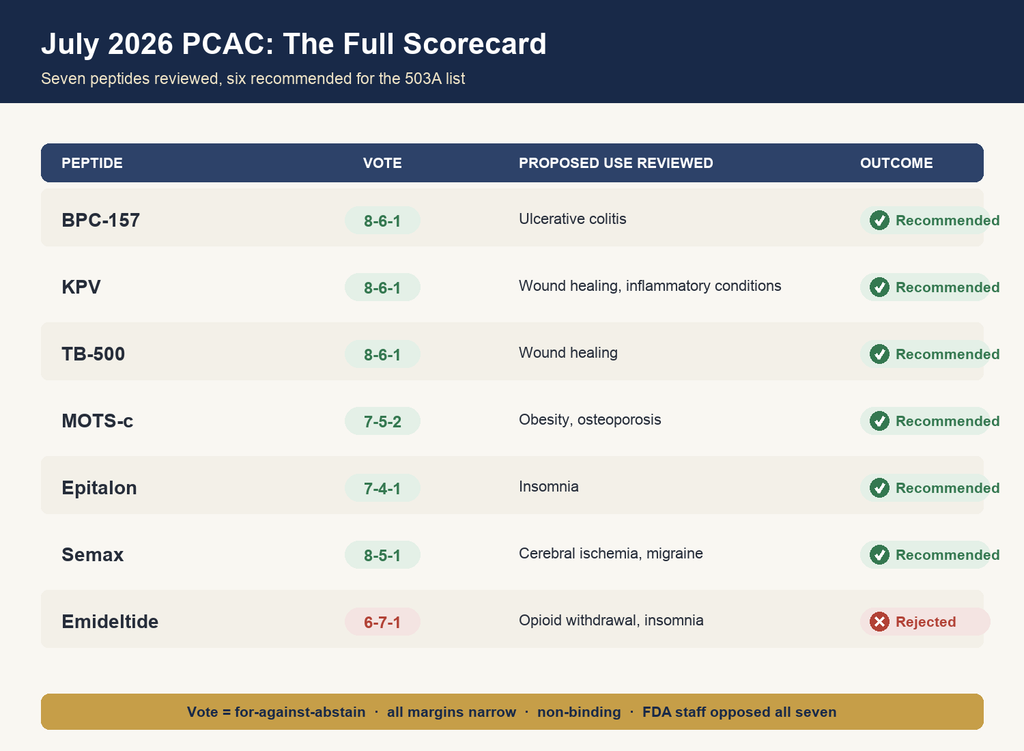
On July 23 and 24, 2026, the FDA’s Pharmacy Compounding Advisory Committee (PCAC) reviewed seven peptides for possible addition to the Section 503A Bulks List, which sets out the bulk substances that compounding pharmacies are allowed to use. The panel recommended six of the seven: BPC-157, KPV, TB-500, MOTS-c, Epitalon, and Semax. Only Emideltide missed the cut.
TB-500 and MOTS-c both landed in the recommended group, with TB-500 backed in its free-base and acetate forms. Here’s the twist that most coverage buried: the FDA’s own career scientists had recommended against all seven peptides, citing short, underpowered studies and gaps in safety and effectiveness data.
The advisory panel voted to recommend anyway, over the objection of FDA staff. That split between the reviewers and the panel is a big part of why the outcome sits in a gray zone: it signals a direction while leaving the real question open.
TB-500: What It Is and What Researchers Study
TB-500 is a synthetic version of a section of thymosin beta-4, a naturally occurring peptide involved in cell movement and tissue repair. It shows up constantly in recovery research, often studied side by side with BPC-157, and the proposed use the FDA weighed was wound healing.
Its mechanism is what makes it interesting in the lab. Thymosin beta-4 binds and sequesters G-actin, the building-block form of the protein cells use to build their internal scaffolding. By managing that actin pool, the peptide helps cells migrate toward a site of injury, a process documented in the research on this actin-sequestering protein.
Preclinical work has linked that same activity to angiogenesis and tissue remodeling across a range of animal models. As with most peptides in this space, the laboratory evidence is broad while human data stays limited, which is precisely the concern FDA staff raised.
MOTS-c: What It Is and What Researchers Study
MOTS-c comes from an unusual place: it’s encoded inside mitochondrial DNA, making it one of a small group of mitochondrial-derived peptides. Metabolic research is its home turf, and the uses the FDA reviewed were obesity and osteoporosis.
The peptide acts mainly through the AMPK pathway, a central regulator of how cells manage energy. Published work describes MOTS-c influencing energy metabolism, insulin sensitivity, and exercise adaptation through AMPK signaling, and notes that the body’s own MOTS-c levels rise with physical activity.
Interest has stayed current, too. A March 2026 study reported that MOTS-c improved muscle mitochondrial performance in a way that depended on the PGC-1alpha and AMPK pathways, adding fresh detail to a mechanism researchers are still mapping.
TB-500 vs MOTS-c: How They Differ
For all that they were voted on together, these two peptides have almost nothing in common beyond their July 2026 status. They come from different biology and get studied for different reasons.
TB-500 traces back to thymosin beta-4 and centers on structural repair, working through actin and cell migration.
MOTS-c is a mitochondrial messenger focused on energy and metabolism, working through AMPK.
One is studied as a repair signal, the other as a metabolic one.
The shared thread is simply that both are synthetic research peptides that drew regulatory attention at the same meeting, and both still need verified quality before any lab work is worth trusting.
What “Recommended” Really Means
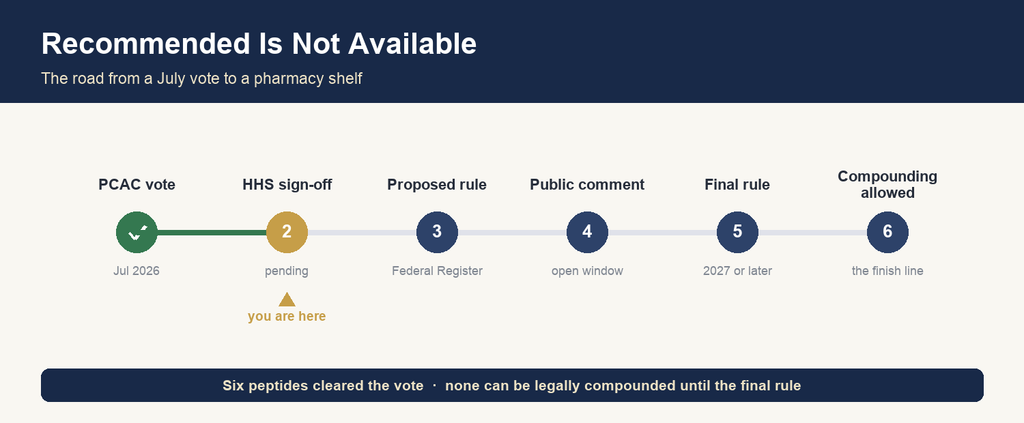
A committee recommendation is a signal, and it stops well short of a green light. The PCAC advises the FDA, so its votes carry weight without binding the agency to anything. Before TB-500 or MOTS-c could be legally compounded, the Secretary of Health and Human Services has to sign off, and the FDA has to complete formal rulemaking, which means a proposed rule, a public comment period, and a final rule published in the Federal Register.
That process is slow by design and typically runs a year or more, which is why the timeline points toward 2027. Until it finishes, pharmacies cannot compound these peptides even if pharmaceutical-grade material exists, and the compounds are not legally available through standard regulated channels. This vote is one piece of a broader FDA peptide review that is still unfolding, and the peptides in play could see their status shift again as the rules take shape.
What It Means for Researchers Right Now
In practical terms, nothing has changed for lab work. TB-500 and MOTS-c remain research-use-only compounds, supplied strictly for in-vitro study and never for human or veterinary use. The July vote is worth watching because it hints at where policy may head, yet it grants no new permissions today.
That makes sourcing discipline more important than ever. A favorable regulatory signal tends to bring a wave of new sellers, and the quality bar is what separates a usable research compound from a questionable one. The regulatory story and the quality story run on parallel tracks, and only one of them is settled.
How TB-500 and MOTS-c Quality Is Verified
Whatever a label promises, two lab tests decide whether a vial holds what it claims. Mass spectrometry confirms identity by weighing the molecule against its expected mass, while HPLC measures how pure the sample is. Read together, they answer the only two questions that matter at the bench: is this the right peptide, and how much of the vial actually is it.
The purity reading rewards a careful eye, since the difference between a 98% and a 99% result is a real change in how much of the sample is something else. Both findings belong on a Certificate of Analysis, and being able to read a COA confidently is what lets you check a claim against your specific batch.
We publish a COA for every lot we ship and stand it on a multi-test quality panel that reaches past purity into the safety checks a percentage alone can’t capture.
Research Blends and Related Compounds
Labs studying tissue-repair pathways often reach for TB-500 as part of a pairing. It anchors a BPC-157 and TB-500 blend built around recovery research, and the same duo forms the core of the Wolverine research kit. TB-500 is also available on its own for single-peptide work.
Each is supplied for laboratory research only, and every unit ships with batch documentation so identity and purity can be confirmed before anything begins.
Frequently Asked Questions
Is TB-500 FDA approved?
No, in July 2026 an FDA advisory committee recommended TB-500 for the Section 503A compounding list, but a recommendation is not approval. It stays research-use-only while final FDA rulemaking plays out, a process expected to continue into 2027.
Is MOTS-c FDA approved?
No, MOTS-c received the same favorable committee recommendation in July 2026, yet it is not FDA-approved and cannot be legally compounded until rulemaking is complete. For now it remains a research-use-only compound.
What peptides did the FDA panel recommend in July 2026?
The committee recommended six of seven peptides for the 503A Bulks List: BPC-157, KPV, TB-500, MOTS-c, Epitalon, and Semax. Emideltide was the one peptide the panel declined to recommend.
Does the committee vote make TB-500 legal?
No. The vote is advisory. The Secretary of Health and Human Services still has to approve the addition, and the FDA has to finish formal rulemaking, so these peptides are not legally available through regulated channels yet.
What is the difference between TB-500 and MOTS-c?
They come from different biology. TB-500 is a thymosin beta-4 fragment studied for tissue repair through actin and cell migration. MOTS-c is a mitochondrial-derived peptide studied for metabolism through the AMPK pathway.
Why did FDA staff disagree with the panel?
FDA reviewers recommended against all seven peptides, pointing to short, underpowered studies and gaps in safety and effectiveness data. The advisory committee weighed the same evidence differently and voted to recommend six of them anyway.
When could TB-500 or MOTS-c actually become available for compounding?
There’s no fixed date. The FDA would need to complete formal rulemaking, which includes a public comment period and a final published rule, and that typically takes a year or more. The realistic window points to 2027 at the earliest, and only if the agency follows the panel.
The Bottom Line
TB-500 and MOTS-c both cleared the July 2026 advisory vote, and that’s genuinely notable, but a recommendation is the start of a long process, with the finish line still well ahead. The peptides remain research-use-only, the FDA’s own scientists remain unconvinced, and final rules are still a year or so out.
For anyone sourcing either compound for laboratory work, the regulatory noise changes little: a verified COA is what tells you a vial is worth your time.
Research use only. Peptides referenced are for in-vitro laboratory research only, not for human or veterinary use, diagnosis, treatment, or consumption. The claims made on this page have not been assessed by the US Food and Drug Administration.
Quick answer: As of August 2026, BPC-157 is not an FDA-approved drug, not a legal dietary supplement, and not yet approved for pharmacy compounding. An FDA advisory committee voted 8-6 in July 2026 to recommend it for the 503A compounding list, but that vote is non-binding and formal rules are still months away. For now, it stays research-use-only.
BPC-157 Legality in 2026
“Is BPC-157 legal?” sounds like a yes-or-no question, and the truthful answer has a few layers. The molecule belongs in different boxes depending on who’s asking: the FDA, a compounding pharmacy, a supplement retailer, or an anti-doping agency each see it differently. The picture also changed twice in 2026, which is where a lot of the confusion comes from. Here’s where each piece actually stands.
This page is regulatory information and general commentary, not legal, medical, or purchasing advice. BPC-157 referenced here is for in-vitro laboratory research only, not for human or veterinary use.
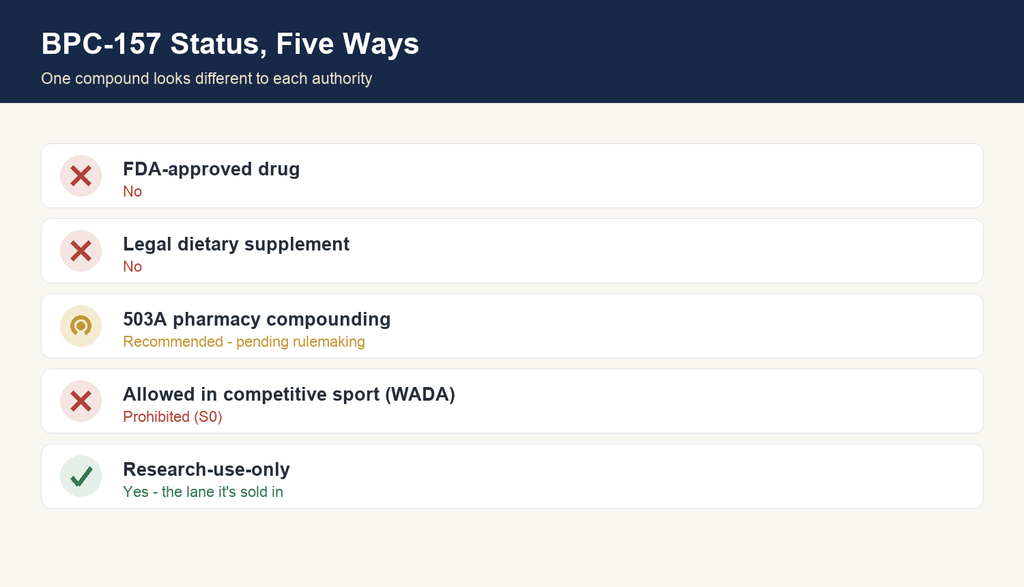
BPC-157 status, five ways
Where it stands
FDA-approved drug
No
Legal dietary supplement
No
503A pharmacy compounding
Recommended in July 2026, pending rulemaking
Allowed in competitive sport (WADA)
Prohibited (S0)
Research use only
Yes, this is the lane it’s sold in
What BPC-157 Is
BPC-157 is a synthetic peptide, a lab-made chain of amino acids based on a sequence found in a protein in gastric juice. Understanding how peptides are built helps here, because BPC-157 is studied for the same reasons many peptides are: it shows up frequently in preclinical tissue-repair and gut research. The science is interesting and still early, which is the backdrop to every regulatory question that follows.
A majority of that evidence comes from cell cultures and animal models, with human clinical data still limited. That research stage is worth keeping in mind, because it’s the reason regulators have moved cautiously and the reason the compound continues to sit in a research setting rather than a pharmacy shelf.
The Two Regulatory Shifts of 2026
Two separate events changed BPC-157’s status in 2026, and mixing them up is the single most common mistake in coverage of this topic. They’re related, yet they do very different things.
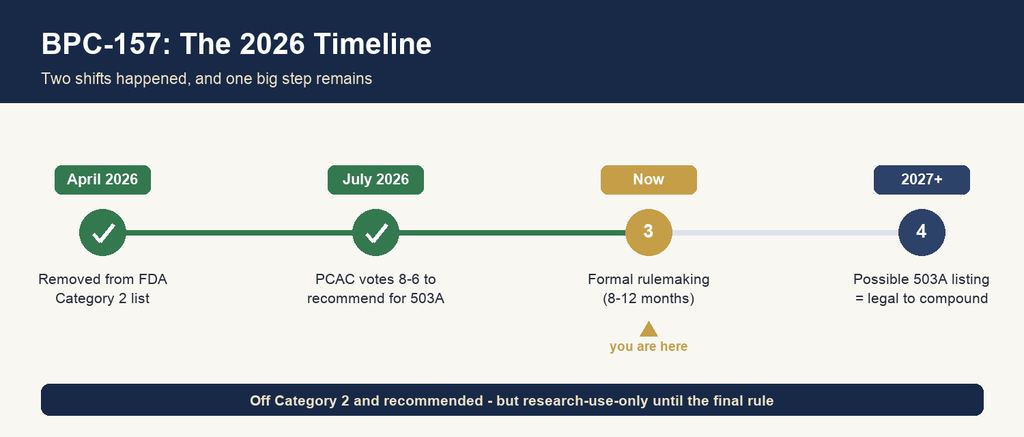
The first change came in April 2026, when the FDA removed BPC-157 from its Category 2 bulk-substances list. Category 2 flagged substances with significant safety questions, and being on it effectively kept compounding pharmacies away. Coming off that list cleared one obstacle, though it did not, on its own, make BPC-157 legal to compound.
The second change came at the July 23 and 24 meeting of the FDA’s Pharmacy Compounding Advisory Committee. The panel voted 8-6 to recommend adding BPC-157 to the 503A Bulks List, tied to a proposed ulcerative colitis indication, and it did so over the objection of FDA staff. That recommendation belongs to a wider review of seven peptides the committee took up across those two days.
So Is BPC-157 Legal in 2026?
The clean answer is that BPC-157 has no approved legal use for humans right now, and a committee vote hasn’t changed that. It helps to take the question one box at a time.
As a drug, it has never been FDA-approved for treating any condition.
As a compounding ingredient, it’s recommended but pending, because the July vote guides the FDA without binding it.
The difference between a recommendation and a rule is where the timeline lives. As regulatory attorney Dustin Robinson of LumaLex Law put it, “the advisory committee’s recommendation still triggers a formal rulemaking cycle that realistically runs eight to twelve months before 503A pharmacies have unambiguous legal authority to compound these substances.” Until that cycle finishes, the honest status is research-use-only.
BPC-157 and Sport: The WADA Line
Athletes have their own version of this question, and the answer there is clear-cut. The World Anti-Doping Agency prohibits BPC-157 at all times under category S0, which covers substances that no health authority has approved for human use. Because BPC-157 fits that description, it’s banned in competitive sport regardless of any FDA compounding decision.
One detail catches people off guard: enforcement can be non-analytical, meaning an athlete can be sanctioned on evidence like admissions or possession, without a positive drug test. The prohibition also reaches U.S. military members under strict-liability rules. WADA’s list moves on its own track, so a future 503A listing wouldn’t lift the sporting ban.
What “Research Use Only” Means
Research-use-only is the label that ties all of this together, and it’s a real legal category. It means BPC-157 is supplied for in-vitro laboratory study, and it carries no clearance for human consumption, self-administration, or clinical use. The designation is about what the compound can be sold and used for, and it holds no matter which way the FDA’s compounding decision eventually goes.
For a lab, that framing is a feature. It sets clear expectations, keeps the work inside the bounds of the law, and puts the focus where it belongs, on the quality and documentation of the material itself.
What’s Next
The story isn’t finished. The FDA still has to run its rulemaking, HHS Secretary Robert F. Kennedy Jr. has a role in approving any addition to the bulk list, and more peptides are queued for advisory review before February 2027. BPC-157 traveled a similar road to peptides like the KPV tripeptide, which cleared the same July vote, while others such as TB-500 and MOTS-c sit at their own points in the process. Anyone tracking BPC-157 closely will be watching the Federal Register, where a proposed rule would appear first.
Why Verified Quality is Still Crucial
Regulatory status tells you what a compound is allowed to be. The contents of the vial on your bench are a separate question, and that one a lab can actually control. Two tests carry the load here. Mass spectrometry and HPLC together handle confirming a peptide’s identity and purity, answering whether the material is truly BPC-157 and how much of the sample is the peptide versus everything else.
We attach paperwork to each batch we make and stand it on the full screen we run on every lot, which covers the safety measures a purity reading alone won’t tell you. Whatever the rules become, that verification is the constant.
Frequently Asked Questions
Is BPC-157 FDA approved?
No. BPC-157 has never been approved by the FDA as a drug for treating any condition. In July 2026 an advisory committee recommended it for the 503A compounding list, but a recommendation is not an approval, and it remains an unapproved substance under ongoing federal review.
Can you legally buy BPC-157 in 2026?
BPC-157 is sold in the United States as a research-use-only compound for in-vitro laboratory work. It cannot be legally marketed as a dietary supplement or as a drug for human use, and no committee vote has changed that.
Is BPC-157 a dietary supplement?
No. Regulators treat BPC-157 as an unapproved drug that doesn’t qualify as a lawful dietary ingredient, so it can’t be sold over the counter as a supplement. That status is separate from the FDA’s compounding review.
Is BPC-157 banned in sports?
Yes. WADA prohibits BPC-157 at all times under its S0 category for non-approved substances. Enforcement can be non-analytical, meaning a sanction can rest on evidence like possession, and the prohibition also reaches U.S. military members.
Are peptides legal in 2026 more broadly?
It depends entirely on the peptide and the use. A handful earned favorable compounding recommendations in July 2026, some are approved drugs in their own right, and many remain research-use-only. There’s no single rule that covers all peptides at once.
What’s the latest news on BPC-157?
The two developments driving 2026 coverage are its April removal from the FDA’s Category 2 list and the July 8-6 advisory vote recommending it for 503A compounding. Both matter, yet neither makes it an approved product, and formal rulemaking is the next milestone to watch.
Does the July 2026 vote make BPC-157 legal to compound?
Not yet. The 8-6 vote was a non-binding recommendation. The FDA still has to complete formal rulemaking, a process one regulatory attorney estimated at eight to twelve months, before pharmacies would have clear authority to compound it.
What does the Category 2 removal mean?
In April 2026 the FDA took BPC-157 off its Category 2 bulk-substances list, which had flagged safety concerns and blocked compounding. Removal cleared one hurdle, but it’s a separate step from being added to the 503A list that would allow compounding.
The Bottom Line
BPC-157 in 2026 is a compound in motion, and its legal picture is easy to overstate in either direction. It came off the Category 2 list, earned a favorable compounding recommendation, and drew real regulatory attention, yet it remains an unapproved drug, an unlawful supplement, a substance banned in sport, and a research-use-only material until formal rules say otherwise.
For anyone working with it in that research setting, the quality of what’s in the vial and solid paperwork behind it are most important while the rules catch up.
Research use only. BPC-157 referenced here is for in-vitro laboratory research only, not for human or veterinary use, diagnosis, treatment, or consumption. This page is general regulatory commentary and not legal advice. The claims made here have not been assessed by the US Food and Drug Administration.
Quick answer: KPV is a tripeptide made of lysine, proline, and valine (Lys-Pro-Val), the last three amino acids at the tail end of alpha-melanocyte-stimulating hormone (alpha-MSH). Preclinical studies focus on its anti-inflammatory signaling in cell and animal models. It carries a research-use-only status, and in July 2026 an FDA advisory committee recommended it for a specific compounding list.
All Eyes on KPV
KPV has become one of the more talked-about small peptides in research circles, and a big FDA meeting in mid-2026 pushed it further into the spotlight. For anyone sourcing it for laboratory work, the useful questions are simple: what is this molecule, how does it behave in published studies, where does it stand with regulators, and how do you know a vial actually contains what the label says. This guide walks through each one.
Research use only. The material below summarizes preclinical (in-vitro and animal-model) findings and regulatory events. It is not medical guidance, and KPV is not approved for human or veterinary use.
KPV at a glance
Full name
Lysine-Proline-Valine (Lys-Pro-Val)
Type
Tripeptide (three amino acids)
Parent molecule
Alpha-MSH, residues 11 to 13 (the C-terminus)
Research focus
Anti-inflammatory and antimicrobial signaling
2026 status
Research-use-only; under active FDA compounding review
What Is KPV?
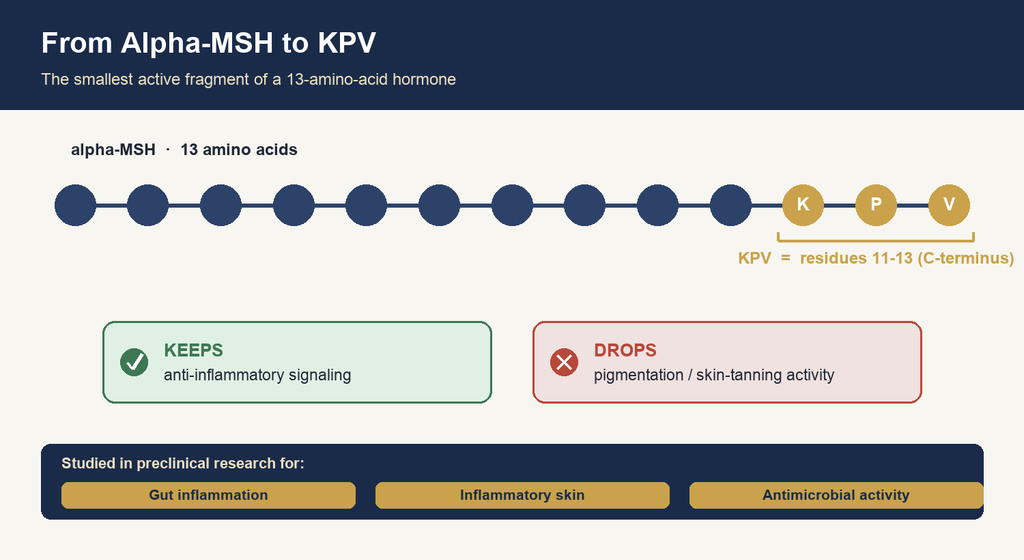
KPV is one of the smallest peptides a lab will handle, just three amino acids linked in a chain. Those three, lysine then proline then valine, sit at the C-terminal end of alpha-MSH, a signaling hormone the body produces naturally. A peptide is simply a short chain of amino acids, so KPV is essentially the tail piece of a larger hormone, snipped down to its shortest active form.
That small size is the whole appeal. Alpha-MSH does several jobs at once, including driving pigment changes in skin. KPV keeps the fragment of the hormone tied to inflammatory signaling while leaving the pigmentation behind, which makes it a cleaner tool for studying one pathway without the rest of the hormone’s activity coming along for the ride.
From Alpha-MSH to KPV: Why the Tripeptide
Researchers didn’t pick three amino acids at random. Alpha-MSH is a 13-residue peptide, and scientists worked backward to find the smallest piece that still calmed inflammation in the lab. That piece turned out to be the C-terminal Lys-Pro-Val sequence.
Getting the molecule this small brings practical advantages for research. A shorter peptide is cheaper to synthesize, easier to characterize, and simpler to keep stable. Published work has described KPV-type tripeptides as attractive candidates precisely because of these physicochemical and pharmacokinetic properties. Stripping the hormone down to its active core gives labs a focused probe for inflammatory signaling, which is why the tripeptide draws more study interest than the full-length hormone.
How KPV Signals in Preclinical Research
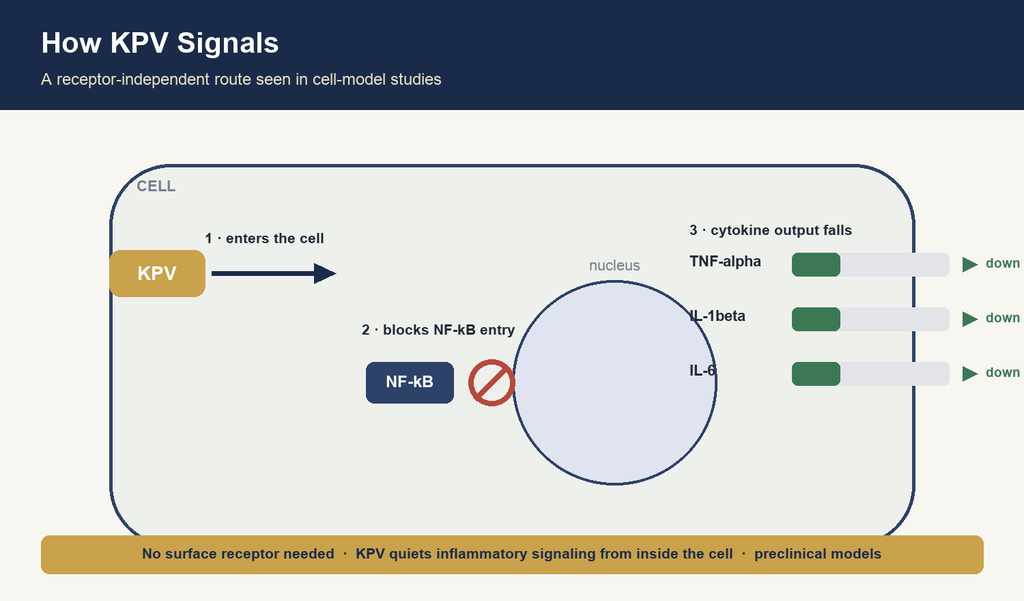
Here’s where KPV gets interesting, because it appears to break the usual rulebook for how a hormone fragment works. A majority of melanocortin peptides act by docking onto a receptor on the cell surface, but KPV seems to skip that step.
In a foundational 2003 study, Getting and colleagues found that KPV’s anti-inflammatory effect is clearly different from that of the core alpha-MSH peptides, and that KPV is unlikely to work through melanocortin receptors, acting instead through inhibition of interleukin-1beta (IL-1beta) functions.
Later work built on this receptor-independent picture. A review of alpha-MSH and its fragments describes how the peptide can enter the cell and directly dampen inflammatory signaling, reducing NF-kappaB and MAP-kinase activity and lowering the output of pro-inflammatory cytokines such as TNF-alpha, IL-1beta, and IL-6.
The takeaway for a researcher is that KPV is studied as an intracellular signaling modulator, one that quiets a cell’s inflammatory response from the inside. That mechanism, drawn from cell and tissue models, is what most current KPV research is built around.
What Researchers Study KPV For
KPV shows up in a few distinct research areas, and all of them trace back to that anti-inflammatory signaling. The evidence base sits at the preclinical stage, which means cell cultures and animal models, with human data still very limited.
Gut inflammation models- KPV has been tested in murine models of inflammatory bowel disease, including DSS-induced colitis and transfer colitis, as Kannengiesser and colleagues reported in 2008. Intestinal work is one of the most active corners of KPV research.
Inflammatory pathway studies- Beyond the gut, labs use KPV as a probe for NF-kappaB and cytokine-driven inflammation in cell models generally.
Skin-inflammation models- The same anti-inflammatory signaling has drawn study interest in skin and wound-related contexts, which is the area the 2026 FDA discussion flagged for possible compounding use.
Antimicrobial activity- The same review that mapped its anti-inflammatory action also noted that alpha-MSH and its C-terminal KPV sequence show activity against microbes including Candida albicans, E. coli, and Staphylococcus aureus, opening a second line of study.
None of this translates to established human uses, and that gap between promising lab signals and proven outcomes is exactly why KPV remains a research compound.
KPV in Research Blends
In practice, labs often encounter KPV inside a combination product. It appears in a BPC-157 and KPV blend, pairing its anti-inflammatory signaling with a peptide studied for tissue-repair pathways, and in the broader KLOW research kit alongside TB-500 and GHK-Cu. These blends are supplied strictly for laboratory research, and each comes with batch-level documentation so the identity and purity of every component can be checked before any work begins.
Why KPV Is in the News: Regulatory Status in 2026
KPV’s profile jumped in 2026 because of a specific regulatory moment. On July 23 and 24, 2026, the FDA’s Pharmacy Compounding Advisory Committee (PCAC) met to evaluate several bulk drug substances, and the panel voted in favor of including KPV on the Section 503A Bulks List for certain uses tied to wound healing and inflammatory conditions.
That vote matters, and it also needs context. A PCAC recommendation is advisory, so it guides the FDA without binding it, and final policy and safety review remain ongoing. KPV is not FDA-approved for any use, and its compounding status has shifted more than once during the year.
This is one of seven peptides that drew regulatory attention in the FDA’s July 2026 review, and the situation is still developing, so the practical stance for a lab is to treat KPV as research-use-only and follow the rulemaking as it unfolds.
How KPV Quality Is Verified
For a tripeptide this small, confirming what’s in the vial is straightforward in principle and essential in practice. Two lab tests carry most of the weight.
Mass spectrometry checks identity by weighing the molecule and matching it to KPV’s expected mass
Together they answer the two questions that’s most important: is this the right molecule, and how much of the vial is actually it?
The purity figure deserves a close read, since the difference between 98% and 99% reflects how much of the sample is something other than KPV. Both results are present on a Certificate of Analysis, and learning how to read a peptide COA line by line turns a purity claim into something you can actually verify against your batch.
We put a batch-specific COA behind every vial we supply, backed by a full multi-test panel that also covers safety measures a purity number alone won’t show.
What to Look For When Sourcing KPV
When you’re comparing KPV suppliers for research, a short checklist separates the credible from the questionable:
A batch-specific COA you can match to your vial’s lot number.
An HPLC purity result with the supporting chromatogram shown.
A mass-spec identity confirmation matching KPV’s expected mass.
Independent third-party testing, with the lab named on the report.
Clear research-use-only labeling and honest regulatory language.
A supplier that hands over all five is one whose numbers you can trust. Anything vaguer deserves scrutiny before it reaches your bench.
Frequently Asked Questions
What is KPV peptide?
KPV is a tripeptide of lysine, proline, and valine, corresponding to the last three amino acids of alpha-MSH. In preclinical research it’s studied for anti-inflammatory signaling. It is a research-use-only compound and is not approved for human or veterinary use.
How does KPV work?
Published cell-model studies suggest KPV works without binding melanocortin receptors. It appears to enter the cell and dampen inflammatory signaling directly, lowering NF-kappaB and MAP-kinase activity and reducing pro-inflammatory cytokine output. This mechanism is drawn from laboratory and animal research.
Is KPV FDA approved?
No, KPV is not approved by the FDA for any use. In July 2026, an FDA advisory committee recommended it for the Section 503A compounding Bulks List for certain uses, but that recommendation is advisory and final policy review is still ongoing.
What is the difference between KPV and alpha-MSH?
Alpha-MSH is a 13-amino-acid hormone with several activities, including pigmentation. KPV is just its C-terminal three residues. That fragment retains the anti-inflammatory signaling studied in the lab while leaving out the pigment-related activity of the full hormone.
How is KPV different from BPC-157?
They’re studied for different pathways. KPV research centers on anti-inflammatory cytokine signaling, while BPC-157 work focuses on tissue-repair pathways. The two are sometimes combined in research blends so labs can study the pathways side by side.
What are the side effects of KPV?
KPV is a research-use-only compound, so it has no established human safety or side-effect profile, and none should be inferred from preclinical work. Published data comes from cell cultures and animal models, and questions about effects in people fall outside the compound’s current research scope.
How do I know a KPV sample is genuine?
Check the Certificate of Analysis. A real one shows an HPLC purity figure with its chromatogram, a mass-spec result confirming identity, and third-party testing tied to your batch number. Documentation is what separates a verified sample from a claim.
The Bottom Line
KPV is a small peptide with an outsized research profile: three amino acids borrowed from alpha-MSH that keep the hormone’s anti-inflammatory signaling while dropping its pigmentary side. The lab evidence is genuinely interesting and still preclinical, the 2026 FDA recommendation is meaningful yet non-binding, and the compound stays research-use-only while the rules settle. If you’re sourcing it for that work, let the COA do the talking, since a verified batch is the only kind worth putting to the test.
Research use only. Peptides referenced are for in-vitro laboratory research only, not for human or veterinary use, diagnosis, treatment, or consumption. The claims made on this page have not been assessed by the US Food and Drug Administration.
Quick answer: A peptide purity figure is the share of the sample that is your target peptide, measured by HPLC. So 98% purity means about 2% of the material is something else, and 99% means about 1% is. Moving from 98% to 99% roughly halves that leftover fraction, which is why sensitive research leans on the higher grade and on the COA that proves it.
98% vs 99% Purity
You’ll see a purity number on the label whenever you buy research peptides: 98%, 99%, sometimes 99.5%. It looks like a simple score, and most buyers read past it in a second. Yet that one figure decides how clean your material is, what the other slice of the vial contains, and whether your results can be trusted. Understanding it takes a few minutes and pays off every time you order.
Purity grade
Leftover fraction
Typically used for
95%
~5% other material
Early screening, method development
98%
~2% other material
Standard cell assays, receptor binding
99%+
~1% other material
Sensitive bioassays, structural and quantitative work
What Purity Measures
Purity is a percentage from high-performance liquid chromatography, or HPLC. The instrument pushes the dissolved sample through a column so its components separate, then a detector reads the ultraviolet light each one absorbs and draws a chromatogram of peaks. Your peptide is the tall main peak, and its purity is that peak’s share of the total peak area. A result of “99% by HPLC” means the target peptide makes up 99% of the UV-absorbing material the detector saw.
That last phrase carries a catch worth knowing. The percentage describes the organic, light-absorbing content, so it says nothing about water, salts, or the counterion left over from synthesis. A vial can read 98% pure on peptide composition and still hold moisture or salt by weight.
Purity tells you how clean the peptide portion is, and a separate net-peptide or salt figure tells you how much actual peptide you’re weighing out. Since every peptide is a defined chain of amino acids, the test is really asking how much of the sample matches that intended chain, and how much drifted off target during manufacture.
What’s in the Other 1 to 2%?
The leftover slice has a name and a story. Peptides are built one amino acid at a time, and every coupling step has a small chance of failing. Those small failures pile up as the chain grows, which is why longer peptides are harder to make clean. The result is a handful of predictable impurities that HPLC separates out.
Truncated sequences, where the chain stopped short and is missing amino acids from the end.
Deletion sequences, where a coupling failed mid-chain and one internal amino acid is missing.
Oxidized variants, where a residue such as methionine picked up oxygen after synthesis.
Residual reagents and counterions, most often trifluoroacetic acid (TFA) salt carried over from purification.
Solvent traces left behind during processing.
None of these are exotic. They’re the normal fingerprints of solid-phase synthesis, and a good lab openly measures and reports them on the COA. Knowing what the impurities are is what lets you judge whether a 98% and a 99% sample differ in ways that touch your work.
98% vs 99%: Does That 1% Matter?
On paper the gap looks tiny. In practice it depends on how you see it. Going from 98% to 99% takes the leftover fraction from roughly 2% down to 1%, so you’re cutting the impurity load close to half. Framed that way, the “1% difference” is really a halving of everything that isn’t your peptide.
Whether that halving changes your outcome comes down to the application. For early screening or method development, 98% is usually plenty, and paying up for 99% buys little. For sensitive bioassays, structural biology, or quantitative receptor-binding studies, the extra grade earns its keep, because even minor impurities can skew a sensitive readout.
There’s also a more silent reason the profile is important: research on generic peptide products has shown that peptide-related impurities can carry measurable immunogenicity risk, as a 2025 immunogenicity risk assessment in a regulatory review documented. Impurities aren’t inert filler, so the makeup of that last 1 to 2% can matter as much as its size.
Why the Method Matters as Much as the Number
A purity figure is only as good as the test and the lab behind it. Two vials both stamped “99%” can come from different processes with different impurity profiles and different batch-to-batch consistency, so the number alone doesn’t settle the question. What settles it is the evidence.
Start with the chromatogram, the actual HPLC trace, since a clean single peak backs up the percentage in a way a bare number cannot. Pair it with a mass-spec result that confirms the peptide is the right molecule, because purity and identity are two separate questions and a sample can be pure yet wrong. Then check who ran the tests, since an independent third-party lab has no stake in the result. All of this lives on the Certificate of Analysis, and learning to read a peptide COA field by field turns a purity claim into something you can verify. Every batch we sell has $1its own published COA$2 for exactly that reason.
Why Higher Purity Costs More
The price jump between grades reflects real work behind the label. Pushing a peptide from 98% to 99% usually means more preparative HPLC, tighter fraction-collection windows, and more of the good material lost at the edges of each collection.
You’re paying for extra purification passes and the yield sacrificed to reach them. That’s also why an unusually cheap “99%” peptide is worth a second look, since the purification that grade demands has a real cost that honest pricing reflects.
The Regulatory Bar
Regulators treat even sub-1% impurities as serious business, which puts the 98-versus-99 question in useful context. Under the FDA’s guidance for highly purified synthetic peptide drug products, any impurity above 0.10% of the active ingredient has to be individually identified, and a new impurity above 0.5% can block approval outright, per the agency’s published synthetic peptide guidance. Those are pharmaceutical thresholds and research material sits in a different lane, but the numbers show how much a fraction of a percent can weigh when quality is on the line.
The topic is live right now. With the FDA’s July 2026 review of seven peptides and its synthetic-peptide impurity guidance under active revision, verifiable purity has rarely been more relevant. One caution the numbers don’t cover: a purity percentage speaks to organic cleanliness on the chromatogram, and it says nothing about bacterial endotoxin, heavy metals, or sterility. Those are separate safety tests, which is why the strongest suppliers back a purity figure with a full testing panel that covers those safety measures too.
What to Look For
When you’re comparing purity claims, a short checklist keeps you honest:
A stated purity backed by a visible HPLC chromatogram.
A mass-spec result confirming the peptide’s identity.
Testing by an independent third-party lab, named on the report.
A batch or lot number that matches your vial.
Clarity on net peptide content if salt weight matters for your dosing math.
Tick those boxes and the difference between a real 98% and a real 99% becomes something you can act on with confidence.
Frequently Asked Questions
Is 98% purity good for a peptide?
Yes, for most research uses. At 98%, roughly 2% of the material is other organic content, which is fine for standard cell assays, receptor binding, and method development. Sensitive quantitative or structural work is where stepping up to 99% starts to pay off.
What is a good purity level for research peptides?
Above 95% is the general floor for quantitative work, 98% is the common research-grade standard, and 99%+ is the top tier for sensitive studies. The right level depends on your application, and any figure means the most when an independent lab verifies it.
Does the 1% difference between 98% and 99% really matter?
It can. Moving from 98% to 99% roughly halves the impurity load, from about 2% down to 1%. For a sensitive bioassay that halving can protect your signal, while for early screening it usually makes little practical difference.
What does peptide purity actually mean?
It’s the percentage of the sample that is your target peptide, measured as the main peak’s share of UV-absorbing material on an HPLC chromatogram. It describes organic cleanliness, so it doesn’t account for water, salt, or safety measures like endotoxin.
How can I tell if a peptide is genuinely high quality?
Look past the headline percentage to the proof behind it: an HPLC chromatogram, a mass-spec identity confirmation, and third-party testing, all tied to your batch on a Certificate of Analysis. Quality is what the documents prove.
The Bottom Line
The difference between 98% and 99% peptide purity is small on the label and meaningful in the vial, since that single point roughly halves what isn’t your peptide. The percentage tells you how clean the peptide portion is, the impurity profile tells you what the rest contains, and the COA behind it tells you whether to believe either one.
Match the grade to your application, insist on the chromatogram and the mass-spec confirmation, and let an independent lab settle the number. That’s the standard every batch we sell is built to meet.
Quick answer: HPLC and mass spectrometry answer two different questions about a peptide. HPLC measures how pure a sample is by separating it into its parts and reporting the percentage that is the target peptide. Mass spectrometry measures the molecule’s mass to confirm the sample is the peptide it claims to be. A trustworthy Certificate of Analysis reports both, because purity and identity together are what tell you the material is right and clean.
HPLC vs Mass Spectrometry
Buy a research peptide and the quality of your whole experiment rests on two numbers on a lab report. One is a purity figure from HPLC. The other is an identity check from mass spectrometry. They sound similar and get lumped together, yet each answers a question the other cannot, and knowing the difference is the fastest way to read a COA with confidence.
Question you are asking
The test that answers it
What it reports
How much of this is the peptide?
HPLC
A purity percentage
Is this actually the right peptide?
Mass spectrometry
Observed mass vs expected mass
Is the material also safe to use?
Separate assays
Endotoxin, sterility, and more
HPLC: How Pure Is It?
High-performance liquid chromatography is the purity test. It pushes the dissolved sample through a packed column, and the sample’s components travel at different speeds and come out separated. A detector watches them exit and draws a chromatogram, a chart of peaks where each peak is a component.
The target peptide forms the tall main peak, and any impurities show up as smaller peaks around it. Purity is the main peak’s share of the total peak area, so a result of “99.2% by HPLC” means the peptide accounts for 99.2% of everything the detector saw. A lot of peptide work uses reverse-phase HPLC with the detector reading ultraviolet light at around 214 to 220 nanometers, the wavelength where the peptide bond absorbs.
What HPLC gives you is a clean, quantified answer to one question: how much of this vial is the peptide, and how much is something else. If you want to understand why a stated 99% can still vary in what it means, the gap between an unverified 98% and a verified 99% is where that story lives.
Mass Spectrometry: Is It the Right Molecule?
Mass spectrometry is the identity test. It measures the molecular mass of the compound in the vial and lets you compare that measured value against the mass expected from the peptide’s amino-acid sequence. When the observed mass matches the expected mass, identity is confirmed.
This matters because purity says nothing about correctness. A sample can be 99% pure and still be the wrong peptide, or the right sequence with a modification you did not order. Since every peptide is a specific chain of amino acids, its true mass is fixed, and mass spectrometry is how you check the material lives up to that number.
The sample is first ionized, most often by electrospray ionization (ESI), which gently charges the molecules so the instrument can weigh them. The output is a mass spectrum, and the peak you care about sits at the peptide’s mass. In short, HPLC tells you how much, and mass spectrometry tells you what.
Is HPLC the Same as LC-MS?
No, though they are close relatives. HPLC is the separation step on its own, ending at a detector that measures light. LC-MS, or liquid chromatography-mass spectrometry, plugs a mass spectrometer onto the end of that same separation, so the sample is separated first and then weighed. You get the purity view and the identity view from one run.
That pairing is why you often see LC-MS named on a peptide COA. It is HPLC’s separating power feeding directly into the mass spectrometer’s identifying power. Research on peptide quality control notes that combined liquid chromatography and high-resolution mass spectrometry “are capable of detecting and identifying co-eluting impurities at low levels,” as Zeng and colleagues reported in The AAPS Journal. In other words, joining the two catches problems that a purity number alone can hide.
Why You Want Both
A COA that reports only one of the two is telling you half the story. HPLC purity without an identity check leaves open the possibility that the clean-looking sample is the wrong compound. A mass confirmation without a purity figure leaves open how much of the vial is actually that compound. Read together, they close both gaps at once.
The science backs up reading them side by side. Mass spectrometry is sensitive to the exact structure, and as Zeng and colleagues explain, “changes to the primary amino acid sequence due to degradation, truncation, insertion, substitution, or deletions typically result in detectable mass shifts.” So the mass number does double duty: it confirms the right peptide and flags a wrong one.
Building on that, a review in Pharmaceutical Research by McCarthy and colleagues points out that confident characterization “often requires multiple orthogonal techniques” read together. Two views of the same batch simply beat one.
What HPLC and Mass Spectrometry Do Not Catch
Even together, these two tests have blind spots, and a genuine lab report accounts for them. Knowing the limits is what separates reading a COA from truly understanding it.
HPLC and mass spectrometry both struggle with mirror-image molecules. A D-amino acid substituted for its normal L-form has the identical mass and can travel through the column at the same speed, so it can slip past both a standard purity trace and a mass check. Neither test reports the salt form or counterion the peptide is paired with, which affects how much actual peptide you are weighing out. Neither one measures biological potency, since a molecule can be pure and correctly identified and still behave differently in an assay.
The bigger point is safety. Purity and identity say nothing about whether the material is free of bacterial endotoxin, sterile, or clear of heavy metals. Those are separate assays a lab only runs when asked, which is exactly why the strongest COAs go beyond HPLC and mass spec. A batch that passes purity and identity has cleared two important hurdles, and the safety hurdles are their own tests entirely.
Reading Both on a COA
When reviewing a Certificate of Analysis (COA), look for the HPLC and mass spectrometry results in their respective sections.
The HPLC result gives you a purity percentage and, on a good report, the chromatogram behind it.
The mass-spec result gives you an observed mass next to the expected mass, and they should agree within the instrument’s small tolerance.
Find the batch or lot number on the report first, then read the two results in that order: identity to confirm the compound is right, purity to confirm it is clean.
The full field-by-field walkthrough of reading a peptide COA covers the rest of the document, from dates to the testing lab.
One habit protects you more than anything: check who ran the tests. An independent, third-party lab has no stake in the result, so the figures stand on their own. We conduct our peptide quality analysis through ISO accredited Janoshik Analytical and domestic labs for multi-level testing that most vendors shy away from.
Frequently Asked Questions
Is HPLC or mass spectrometry better?
Neither is better, because they answer different questions. HPLC measures purity, and mass spectrometry confirms identity. The strongest peptide testing uses both, so a COA can tell you at once that the material is the right compound and that it is clean.
What HPLC purity is good for a research peptide?
Many labs look for 99% or higher for quantitative and publication-grade work, with 95% or above workable for early screening. The purity figure means the most when it is verified by an independent lab and backed by the chromatogram that produced it.
What is ESI in mass spectrometry?
Electrospray ionization (ESI) is the most common way peptides are prepared for mass spectrometry. It gives the molecules a gentle electric charge so the instrument can measure their mass without breaking them apart, which makes it well suited to intact peptides.
Do you really need both tests, or is one enough?
You want both. A purity result on its own leaves identity unconfirmed, and an identity result on its own leaves purity unknown. Reading the two together is what turns a lab report into real confidence in the vial.
Can HPLC and mass spec confirm a peptide is safe?
No, and this is the common misunderstanding. They confirm purity and identity, while safety measures like endotoxin and sterility are separate assays. A complete quality picture reads the purity and identity results alongside those safety tests.
The Bottom Line
HPLC and mass spectrometry are the two pillars of peptide testing, and each carries half the weight. HPLC tells you how pure the sample is, mass spectrometry tells you what it actually is, and a COA that reports both, verified by an independent lab, gives you a batch you can trust. With the FDA taking a closer look at peptide compounding in its July 2026 review, being able to read these results has never counted for more.
That is the thinking behind the third-party testing panel we run on every batch, where HPLC and mass spec are the first two of six checks, and every result lands on a COA you can read before you buy.
Quick answer: On July 23 and 24, 2026, the FDA’s Pharmacy Compounding Advisory Committee (PCAC) reviewed seven peptides for the Section 503A compounding list and recommended six of them: BPC-157, KPV, TB-500, MOTS-c, Epitalon, and Semax. Only Emideltide was voted down. Every vote was narrow, none is binding, and nothing is approved yet.
Current Status of Peptides the FDA Reviewed in July
For a corner of science that usually grows quietly, the July 2026 advisory meeting was a genuinely big deal. Over two days, a federal committee weighed whether seven research peptides should be available through compounding pharmacies, and it backed most of them. The votes were close, though, and the fine print is just as important as the headline. Here’s the full scorecard, what each peptide was reviewed for, and how much really changed.
Research use only. This page summarizes a regulatory event and preclinical research context. It is not medical guidance, and none of these peptides is approved for human or veterinary use.
What Happened Over the Two Days
The PCAC exists to advise the FDA on which bulk substances compounding pharmacies may use under Section 503A. Across July 23 and 24, the committee reviewed seven peptides and recommended six for the 503A Bulks List. The one it declined was Emideltide.
The votes were tight, and the FDA’s own scientists were against the whole slate. During the meeting, FDA reviewers recommended against inclusion of all seven, citing concerns about safety, efficacy, and how well each molecule is characterized. The advisory panel looked at the same evidence and voted the other way on six of them. That gap between the reviewers and the committee is the tension running underneath this entire story.
Peptide
Committee vote
Outcome
Proposed use reviewed
BPC-157
8-6-1
Recommended
Ulcerative colitis
KPV
8-6-1
Recommended
Wound healing, inflammatory conditions
TB-500
8-6-1
Recommended
Wound healing
MOTS-c
7-5-2
Recommended
Obesity, osteoporosis
Epitalon
7-4-1
Recommended
Insomnia
Semax
8-5-1
Recommended
Cerebral ischemia, migraine, neuralgia
Emideltide
6-7-1
Not recommended
Opioid withdrawal, insomnia, narcolepsy
The Six the Panel Backed
Each recommended peptide came to the table with a specific proposed use, and the committee’s vote reflected how it weighed the research behind that use.
BPC-157 drew a wound-and-gut research profile, and the use reviewed was ulcerative colitis. It passed 8-6 with one abstention.
TB-500 and MOTS-c were reviewed for wound healing and for obesity and osteoporosis respectively, and both landed favorable votes. Their regulatory and research picture is worth a closer look on its own.
Epitalon, a synthetic tetrapeptide studied in longevity research, was reviewed for insomnia and passed 7-4 with one abstention.
Semax cleared 8-5 with one abstention, reviewed for neurologic uses including cerebral ischemia and migraine.
For anyone new to these compounds, it helps to remember that a peptide is a short chain of amino acids, and each of these six is studied in its own research lane despite sharing a July vote.
The One That Was Rejected
Emideltide, a delta sleep-inducing peptide known in the literature as DSIP, was the only compound the committee declined to recommend. Its vote came in at 6 in favor, 7 against, and 1 abstention, the narrowest margin of the meeting.
The proposed uses reviewed were opioid withdrawal, insomnia, and narcolepsy. A rejection here doesn’t close the door for good, and compounds that fell short can return with stronger data at a future review.
Why FDA Staff Pushed Back
The staff objection is the thread that ties the meeting together, and it’s worth understanding. FDA reviewers looked at the evidence packages for all seven peptides and found them wanting, pointing to short and underpowered studies, thin human safety data, and gaps in how completely each molecule is characterized.
Those concerns didn’t sink the votes, since the advisory committee is free to disagree, but they signal how the agency itself is likely thinking as it moves toward a final decision.
What “Recommended” Actually Means: The Road Ahead
A favorable committee vote is a milestone, and it sits a long way from the finish line. The recommendation guides the FDA without binding it, so more has to happen before any of these peptides could be legally compounded.
The Secretary of Health and Human Services has a role here, and reporting suggests the agency could add recommended peptides to a Category 1 list on an interim basis or signal enforcement discretion while the rules are worked out.
The durable path, though, runs through formal notice-and-comment rulemaking: the FDA publishes a proposed rule, opens a public comment window, weighs the responses, and issues a final rule in the Federal Register. That process is deliberately slow and may stretch into 2027 or beyond. Until it wraps, pharmacies cannot compound these peptides, even the six with a favorable vote.
What’s Next Before February 2027
The July meeting opened a chapter, and the story keeps moving. The FDA has signaled that more peptides are queued for PCAC review before February 2027, so the bulk list is likely to keep shifting over the coming months.
Stakeholders watching this space are keeping an eye on the Federal Register, where any proposed rule would surface first. For the seven already reviewed, the next real movement depends on how quickly the agency chooses to act on its committee’s advice.
What It Means for Researchers Right Now
For laboratory work, the practical answer is that little has changed. All seven peptides remain research-use-only compounds, supplied strictly for in-vitro study and never for human or veterinary use. The votes hint at where policy could head, yet they grant no new permissions today, and the compounds are not legally available through standard regulated channels.
If anything, a burst of regulatory attention is a reason for more care, since headlines tend to attract new sellers of uneven quality. The regulatory question and the quality question are separate, and only one of them moves on the FDA’s timeline.
Why Quality Still Decides Everything
No committee vote tells you what’s actually in a vial, and that’s where a lab’s diligence earns its keep. Identity and purity are the two things worth confirming before any research begins, and two tests handle them. Mass spectrometry weighs the molecule to verify it matches the intended peptide, while HPLC reports how pure the sample is. The purity number rewards attention, too, since the step from 98% to 99% marks a real change in how much of the sample is anything but the target.
Both results should appear on a Certificate of Analysis tied to your specific batch, and getting comfortable reading a COA is what turns a supplier’s claim into a fact you can check.
We attach a COA to every lot and back it with a broader testing panel that reaches into the safety measures purity alone leaves out. Whatever the FDA decides, that documentation is what makes a research peptide worth choosing.
Frequently Asked Questions
Which peptides did the FDA recommend in July 2026?
The PCAC recommended six of the seven peptides reviewed: BPC-157, KPV, TB-500, MOTS-c, Epitalon, and Semax. Emideltide was the only one the committee voted down, on a narrow 6-7 margin with one abstention.
Are these peptides FDA approved now?
No, a committee recommendation is advisory, and it stops short of approval. Before any of these peptides could be legally compounded, the FDA has to complete formal rulemaking, a process expected to run into 2027 or later. All remain research-use-only for now.
What is the 503A Bulks List?
It’s the FDA’s affirmative list of bulk drug substances that compounding pharmacies are permitted to use under Section 503A. Adding a peptide to it is what would let pharmacies legally compound with it, and that addition still requires formal rulemaking.
Why did FDA staff recommend against the peptides?
FDA reviewers cited short, underpowered studies, limited human safety data, and gaps in how well each molecule is characterized. The advisory committee weighed the same evidence differently and recommended six of the seven anyway.
Which peptide did the committee reject, and why?
Emideltide, a delta sleep-inducing peptide (DSIP), was voted down 6-7 with one abstention. It had been reviewed for opioid withdrawal, insomnia, and narcolepsy. Peptides that fall short can return to a later review with stronger data.
When could these peptides become available for compounding?
There’s no set date. Formal rulemaking includes a public comment period and a final published rule, which typically takes a year or more, pointing toward 2027 at the earliest and only if the FDA follows its committee.
What are the risks around these research peptides?
The FDA’s reviewers flagged limited human safety data and incomplete characterization for all seven, which is part of why they urged caution. For lab use, the practical risk is quality: an unverified peptide can be impure or misidentified, so batch testing and a COA matter regardless of regulatory status.
The Bottom Line
The July 2026 review moved the peptide conversation forward without settling it. Six of seven compounds earned a favorable committee vote, the margins were slim, the FDA’s own scientists remain skeptical, and the rulemaking that would make anything official is still ahead. For researchers, the takeaway is steady: the rules are in motion, the status is unchanged, and a verified COA is still what separates a peptide worth studying from one worth skipping. You can browse our research-grade catalog with that standard in mind.
Research use only. Peptides referenced are for in-vitro laboratory research only, not for human or veterinary use, diagnosis, treatment, or consumption. The claims made on this page have not been assessed by the US Food and Drug Administration.
A lot of the 2026 peptide news comes down to four characters: 503A. If you’ve seen headlines about the FDA “adding peptides to the compounding list,” this is the list they mean. Here is a plain-English explanation and why the July 2026 vote matters. (General information, not legal advice.)
What is the 503A bulk list?
Section 503A of the Federal Food, Drug, and Cosmetic Act governs traditional pharmacy compounding — when a licensed pharmacist or physician prepares a medication for an individual patient. To compound with a bulk drug substance, that substance generally must meet one of three conditions: it is a component of an FDA-approved drug, it has a USP or NF monograph, or it appears on the FDA’s 503A bulk substances list. The list is, in effect, a gateway for substances that do not otherwise qualify.
Why it matters for peptides
Most research peptides have no USP monograph and are not part of an approved drug — so the 503A list is effectively the only formal compounding pathway open to them. That is why the July 2026 vote to recommend BPC-157 and KPV for the list drew so much attention: it is the first time a US body has moved to formally recognize these compounds for compounding.
What it does not mean
Being recommended for — or even added to — the 503A list does not make a peptide an FDA-approved drug, and it does not authorize retail sale or general human use. It concerns compounding pharmacies specifically. Research-use-only materials, like those in our catalog, remain intended for laboratory research only. For peptide-by-peptide status, see the July review roundup.
Research use only. Peptides referenced are for in-vitro laboratory research only, not for human or veterinary use, diagnosis, treatment, or consumption. This is regulatory and general information, not legal, medical, or purchasing advice.
Sources: FDA Pharmacy Compounding Advisory Committee meeting, July 23–24, 2026; RAPS and Drug Topics coverage; STAT, NPR, and Time reporting.