
Quick Answer
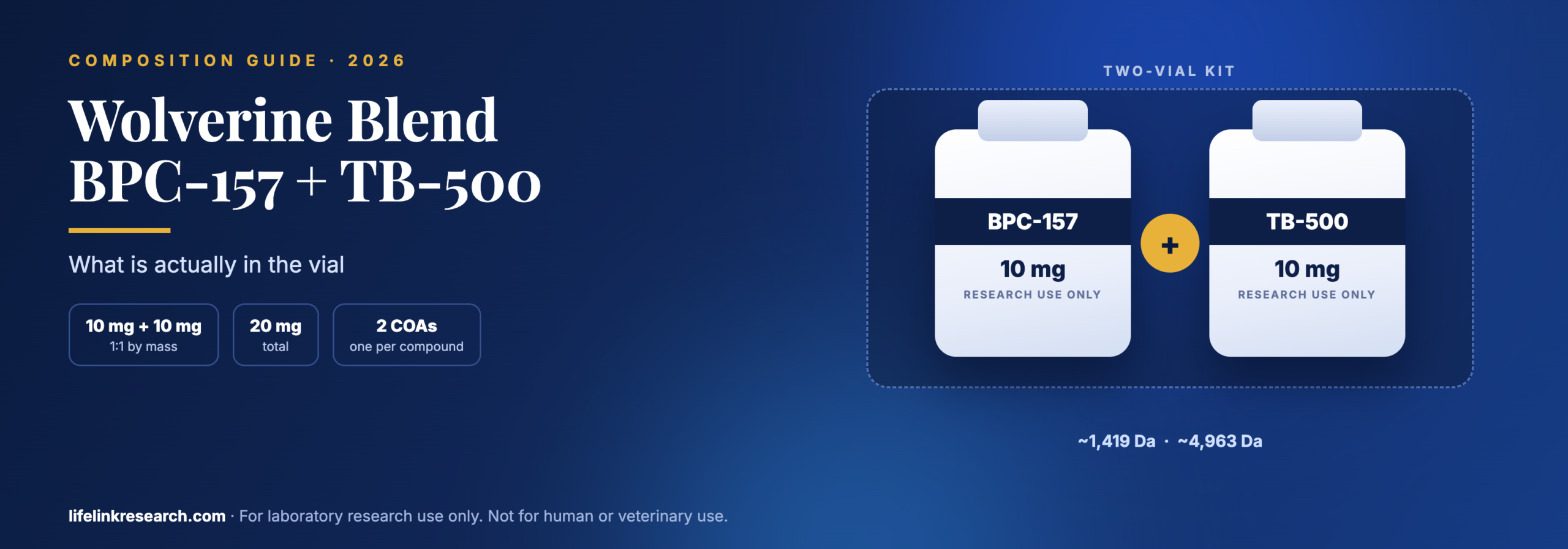
“Wolverine” is the market nickname attached to a pairing of two research peptides, BPC-157 and TB-500, usually supplied at 10mg each (20mg in total, a 1:1 ratio). Suppliers ship it two ways: premixed in a single vial, or as a kit holding one vial of each. No regulator has approved it, and it is sold for laboratory research only.
Key takeaways
- Two compounds: BPC-157 (15 residues) and TB-500
- Usually 10mg + 10mg, a 1:1 ratio
- “TB-500” can mean the full protein or a 7-residue fragment, so check the label
- A blend COA must show both compounds separately
- Separate vials mean a separate COA for each
Two vials can both read “TB-500 10mg” and hold molecules that differ more than fivefold in mass. One is thymosin beta-4, a 43-residue protein near 4,963 Da. The other is Ac-LKKTETQ, a seven-residue fragment near 889 Da. Same label, same milligrams, very different contents, and the wolverine blend is where that ambiguity turns up most often, because the name travels further than any specification sheet.
What follows covers the composition of a wolverine peptide combination, the formats it ships in, how to read a two-component certificate, and what US supply looks like. Life Link’s own two-vial BPC-157 + TB-500 kit is used as the worked example throughout.
What Is the Wolverine Blend?
Quick answer: Wolverine is the catalog name given to BPC-157 and TB-500 when they are sold as a pair, most often at 10mg each. The nickname belongs to nobody, and no regulator has assessed anything bearing it. Labels vary between sellers, so the contents line and the batch certificate are the parts that actually describe the material.
The nickname came from supplier catalogs and forum shorthand, not from any laboratory or registry. Nobody holds a trademark on it, which is exactly why two listings under the same name can hold different material.
Three formats share the label:
- Blend (one vial). Both peptides freeze-dried together in a single vial at a fixed ratio.
- Kit (separate vials). Each peptide in its own vial, boxed together. Kit is the accurate word for this format, since nothing is actually combined.
- Capsules. An oral format, outside the scope of this guide.
Throughout the rest of this guide, the combination is called a BPC-157 + TB-500 blend, because that names what is in the vial.
What Is in the Wolverine Blend?
Quick answer: A standard Wolverine blend contains BPC-157 (10mg) and TB-500 (10mg), 20mg in total. BPC-157 is a synthetic 15-residue peptide; TB-500 is either full-length thymosin beta-4 or a short fragment of it, depending on the supplier.
Every value below was read from PubChem and UniProt on October 25, 2026.
| Component | Amount | Type | Sequence / size | Molecular weight | CAS |
| BPC-157 | 10 mg | Synthetic 15-residue peptide | GEPPPGKPADDAGLV | ~1,419.5 g/mol (CID 9941957) | 137525-51-0 |
| TB-500 (full-length) | 10 mg | Thymosin beta-4, 43 residues, N-acetylated | SDKPDMAEIEKFDKSKLKKTETQEKNPLPSKETIEQEKQAGES (UniProt P62328) | ~4,963 g/mol (CID 45382195) | 77591-33-4 |
| TB-500 (fragment) | 10 mg | Ac-LKKTETQ, a 7-residue fragment | LKKTETQ, acetylated | ~889 g/mol (CID 62707662) | 885340-08-9 |
The BPC-157 row is settled: one sequence, one mass, one CAS number. The TB-500 rows are the reason this table has three entries instead of two.
Which “TB-500” Is in Your Vial?
Quick answer: Sellers use “TB-500” for two different molecules: full-length thymosin beta-4 (43 residues, about 4,963 Da) and a 7-residue fragment, Ac-LKKTETQ (about 889 Da). Both can be labelled “TB-500 10mg”. The COA’s measured mass tells you which one you bought.
PubChem keeps them as separate records, and the names on those records are the clearest evidence that the field uses one label for two compounds. Search “TB-500” and you land on the 889 Da fragment. Search “thymosin beta-4” and you land on the 4,963 Da protein. Both are legitimate entries, and catalogs borrow freely from each.
The arithmetic is where it lands:
| Molecule | Mass | Molecules per 10 mg (approximate) |
| Thymosin beta-4, 43 residues | ~4,963 Da | 2.0 µmol |
| Ac-LKKTETQ, 7 residues | ~889 Da | 11.2 µmol |
Ten milligrams of the fragment delivers roughly 5.6 times as many molecules as ten milligrams of the full protein. Two listings at the same price per milligram are not comparable until you know which molecule each one holds.
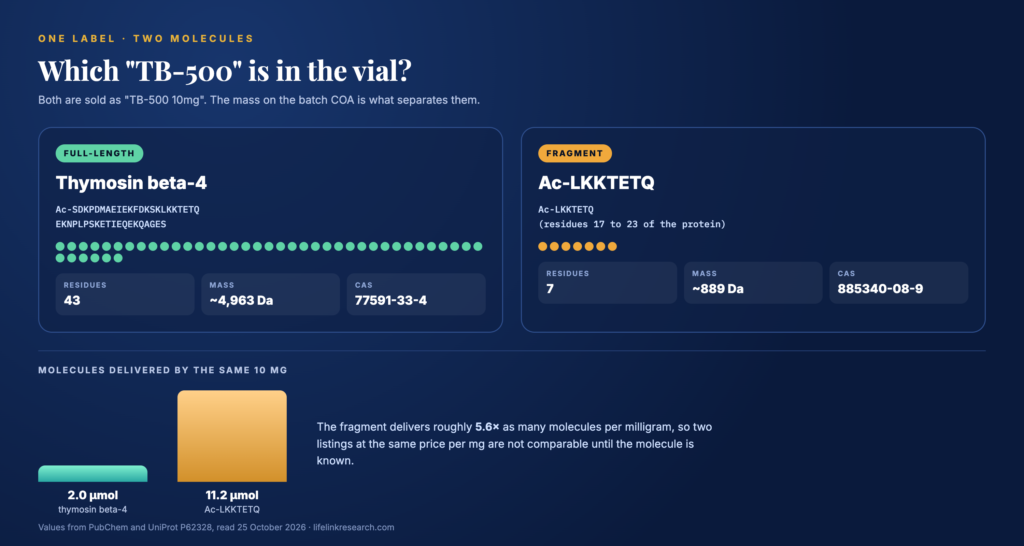
Two molecules sold as TB-500: thymosin beta-4 at 43 residues and the Ac-LKKTETQ fragment at 7 residues
How to check: read the observed mass on the mass-spectrometry line of the batch COA. A result near 4,963 is the full protein; a result near 889 is the fragment. The product name on the label settles nothing on its own.
Life Link’s TB-500 10mg is listed as full-length thymosin beta-4, CAS 77591-33-4, at 4,963.55 Da, and that CAS number and mass both correspond to the 43-residue protein. Confirm it against the mass on the current batch report before relying on it.
Blended Vial vs Two-Vial Kit: Which Format?
Quick answer: A blended vial holds both peptides freeze-dried together at a fixed 1:1 ratio, with one COA covering both. A two-vial kit keeps each peptide in its own vial with its own COA, so each can be checked separately and the ratio is set by the study, not the vial.
| Factor | One blended vial | Two-vial kit |
| Verification | One COA that must name both compounds | One COA per compound |
| Ratio | Fixed at 1:1 | Set by the study design |
| Stability questions | Two peptides stored together | Each stored apart |
| Price per mg | Usually lower | Usually higher |
The verification row is the one that separates the formats in practice. A single report covering a blended vial has to carry two identity results and two purity results, and plenty of them do not. With separate vials, each report is an ordinary single-compound certificate, which is far easier to check and far harder to fudge.
The ratio row cuts the other way. A blended vial fixes the proportion at the point of manufacture, so a design calling for anything other than 1:1 cannot use it. Separate vials leave that choice open.
Life Link stocks both: the BPC-157 + TB-500 10/10mg blended vial at $160, and the two-vial kit at $223.25. For the general case, blends vs single vials covers the trade-off across the catalog.
What Should a Wolverine Blend COA Show?
Quick answer: A blend COA should list BPC-157 and TB-500 separately, each with its own identity result by mass spectrometry and its own purity result by HPLC. Expect two peaks on the chromatogram, not one. A single “Wolverine 99%” line doesn’t show that both compounds are present, or in what amount.
| What to look for | Why it belongs there |
| Both compound names printed separately | A combined name hides which component was measured |
| Two mass results | ~1,419 for BPC-157, plus ~4,963 or ~889 for TB-500 |
| A purity figure for each | Purity by HPLC, read per compound, not as one number |
| Two peaks on the chromatogram | One peak cannot represent two molecules of different mass |
| Batch number matching the vial | Ties the document to the material in hand |
| Lab name, verification code, and test date | Lets the report be checked at source |
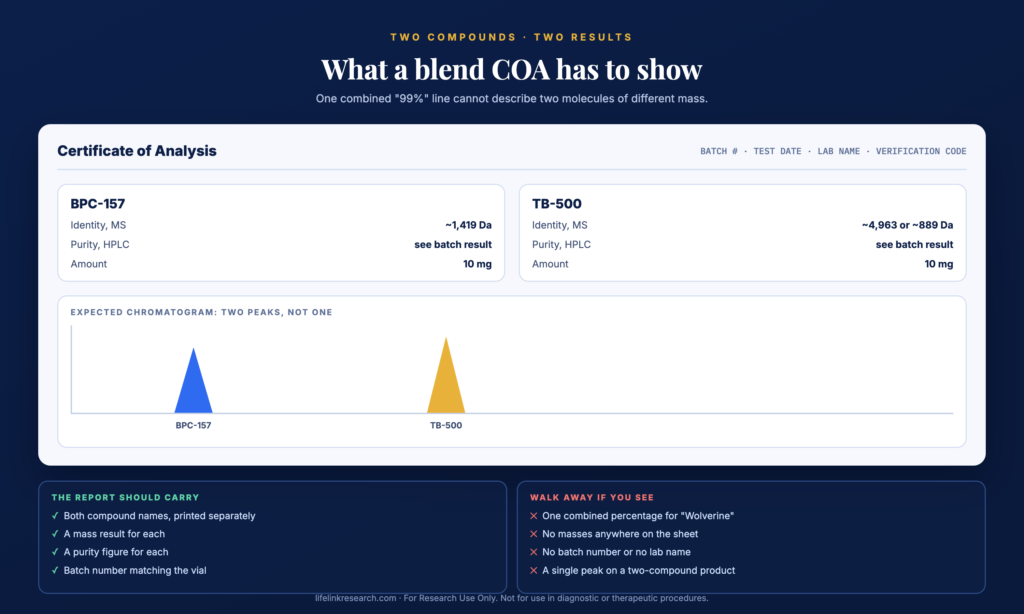
What a BPC-157 and TB-500 blend COA should show, with two peaks on the chromatogram
Red flags are the mirror image: one combined percentage, no masses, no batch number, no lab name.
For a blended vial, the chromatogram is the quickest read. Two compounds at a 5.6-fold or 3.5-fold mass difference separate cleanly on a reverse-phase column, so a single peak on a two-component product is a question worth asking before purchase, not after. Our guides on how to verify a COA is real, and HPLC vs mass spectrometry cover the mechanics of each check.
How Do BPC-157 and TB-500 Differ as Molecules?
Quick answer: BPC-157 is a 15-residue synthetic sequence of about 1,419 Da. TB-500 is one of two things: thymosin beta-4 itself at 43 residues and roughly 4,963 Da, or the seven-residue piece cut from it. They differ in size, origin, and how they are characterised on a COA, which is why each needs its own result.
BPC-157 runs fifteen residues, GEPPPGKPADDAGLV, and its sequence was taken from a larger protein identified in gastric juice. Nothing about it is extracted; the chain is assembled by solid-phase synthesis.
Thymosin beta-4 is a naturally occurring 43-residue protein, catalogued in UniProt as P62328 and N-acetylated at its N-terminus. The LKKTETQ stretch inside it, residues 17 to 23, is the part the short fragment reproduces.
That size difference has a consequence for the “1:1” shorthand. Equal milligrams are not equal molecules. Ten milligrams of BPC-157 is about 7.0 µmol, while ten milligrams of the 43-residue protein is about 2.0 µmol, so a 1:1 blend by mass is closer to 3.5:1 by molar amount. Against the short fragment the same 10mg pairing runs the other way, nearer 1:1.6. A protocol that specifies molar amounts needs the arithmetic done from the mass on the certificate.
Published work on both compounds is mostly rodent and cell-culture studies. A fuller treatment of both molecules is in BPC-157 vs TB-500 compared.
Is the Wolverine Blend Legal or FDA Approved?
Quick answer: No FDA approval exists for BPC-157 or for TB-500, and nothing has ever been reviewed under the name “Wolverine”. In the US, both are supplied as research reagents for laboratory use. An FDA advisory committee took up both compounds in July 2026 for the 503A compounding list, and its recommendation carries no legal force.
The FDA’s calendar entry for the July 23 to 24, 2026 advisory committee meeting names BPC-157 and TB-500 on the first day’s agenda, each listed in free base and acetate forms. The page is marked current as of August 6, 2026. That committee only advises. Anything reaching the 503A list has to clear notice-and-comment rulemaking first, and the list itself governs compounding pharmacies, not the supply of reagents to laboratories. BPC-157’s legal status tracks where that stands.
In sport, both appear on the WADA Prohibited List effective January 1, 2026, in separate sections. The list places BPC-157 in S0, the non-approved substances class, while TB-500 falls under S2, where the entry reads “Thymosin-ß4 and its derivatives e.g. TB-500”. Both carry a ban that applies year-round.
How Should the Wolverine Blend Be Stored?
Quick answer: Keep the sealed freeze-dried vials in a -20°C freezer, shielded from light and kept dry. Bring a vial up to room temperature before breaking the seal, so moisture does not condense inside. Keep each kit vial labelled with its batch number next to its COA.
With a two-vial kit, there is a small record-keeping point: the vials carry different batch numbers and arrive with different certificates. Log them separately on receipt, because once the box is discarded, matching a vial back to its report depends entirely on the label.
Where to Buy the Wolverine Blend in the US
Quick answer: Choose a US supplier that names both compounds on the label, publishes a separate identity and purity result for each, ships from US stock, and sells for research use only. Compare price per verified milligram, and check which TB-500 molecule each listing contains.
Four checks separate a documented listing from a name on a box:
- Both compounds named, with amounts, on the product page itself.
- A batch COA for each compound, published and linked, with the lab named.
- Which TB-500 molecule the listing contains, stated or evident from the mass.
- US stock and research-use-only terms at checkout.
Life Link supplies the combination as a two-vial kit: BPC-157 10mg and TB-500 10mg in separate vials, each with its own certificate, dispatched same day on orders placed before 2 PM PST and shipped UPS 2-Day Air from California. The blended 10/10mg vial is the alternative where a fixed 1:1 ratio suits the work. How to choose a US peptide supplier sets out the wider checklist.
Wolverine Blend FAQs
Why is it called “Wolverine”?
The name spread through supplier catalogs and forum threads; it was never registered as a product. Since no business holds it and no agency has assessed anything carrying it, the contents line on the label and the batch COA describe a purchase far better than the nickname can.
What ratio is the Wolverine blend?
Usually 1:1 by mass: 10mg of BPC-157 and 10mg of TB-500, 20mg in total. That ratio is fixed in a blended vial. In a two-vial kit the amounts are the same, but each compound stays separate, so the proportion used is set by the study rather than by the manufacturer.
Is Wolverine the same as GLOW or KLOW?
No. The Wolverine combination holds two compounds. GLOW adds GHK-Cu to the same pair, making three, and KLOW adds both GHK-Cu and KPV, making four. The naming is catalog convention rather than chemistry, so check each listing’s composition. Our guide to the GLOW blend sets out that composition.
Can I buy BPC-157 and TB-500 separately?
Yes. Both are sold as single-compound vials, each with its own batch certificate, and buying them separately is what a two-vial kit amounts to. BPC-157 10mg is listed on its own at $89, with TB-500 10mg listed separately at $146.
What is the difference between a blend and a kit?
A blend is one vial holding both peptides freeze-dried together, documented by a single COA that has to cover both. A kit is two vials, each with its own COA. The blend fixes the ratio; the kit keeps the compounds and their paperwork separate.
⏱ Wolverine blend in 30 seconds
Two research peptides sold under one nickname: BPC-157 at 10mg and TB-500 at 10mg, 20mg total in a 1:1 ratio. It ships either as a single blended vial or as a two-vial kit. The label “TB-500” covers two different molecules, near 4,963 Da and near 889 Da, so the mass on the batch COA identifies what is actually in the vial.
For Research Use Only. Not for use in diagnostic or therapeutic procedures.
Everything described above is a laboratory reagent, sold only to qualified researchers aged 21 and over. Full sale conditions appear in the Terms and Conditions.
References
- PubChem CID 9941957, BPC-157: https://pubchem.ncbi.nlm.nih.gov/compound/9941957
- PubChem CID 45382195, thymosin beta-4: https://pubchem.ncbi.nlm.nih.gov/compound/45382195
- PubChem CID 62707662, TB-500 (Ac-LKKTETQ): https://pubchem.ncbi.nlm.nih.gov/compound/62707662
- UniProt P62328, thymosin beta-4 (human), 43-residue chain: https://www.uniprot.org/uniprotkb/P62328/entry
- FDA, Pharmacy Compounding Advisory Committee meeting, July 23 to 24, 2026: https://www.fda.gov/advisory-committees/advisory-committee-calendar/july-23-24-2026-meeting-pharmacy-compounding-advisory-committee-07232026
- WADA Prohibited List 2026, effective January 1, 2026: https://www.wada-ama.org/en/prohibited-list
Ipamorelin vs Sermorelin: GHSR vs GHRH Receptor Research Compared
A Novo Nordisk group in 1998 settled which receptor Ipamorelin works through by blocking it. They applied a GHRH antagonist and the…
Read article
KPV vs BPC-157: Molecular Identity, Pathways and Research Compared
A PubMed search run in late October returns 230 records for BPC-157 and 47 for KPV. Exactly one record names both, and…
Read article
What Is MOTS-c? Structure, Research Use & US Supply
Quick Answer MOTS-c is a 16-amino-acid peptide coded within a short open reading frame of the mitochondrial 12S rRNA gene (MT-RNR1). It…
Read articleResearch-grade peptides
99%+ purity. Verified every batch.
Identity and purity tested on every batch by third-party labs, Janoshik Analytical and US-based laboratories. Shipped same day from California.
Shop all peptides